
Project Gaia Exposed: 8 Massive Leaks That Prove Pokémon Gen 10 Is The Switch 2’s Killer App
The wind is shifting. For nearly three decades, we have followed a familiar rhythm. We wake up in a small town, choose a partner from a trio of elemental creatures, and set out on a linear path to conquer eight gyms. It is a formula that has defined childhoods and comforted millions. But as the franchise approaches its thirtieth anniversary in 2026, the air feels different. Game Freak finds itself at a massive crossroads. The developer is not just looking to iterate, they are looking to survive and evolve on the significantly more powerful Nintendo Switch 2 hardware.
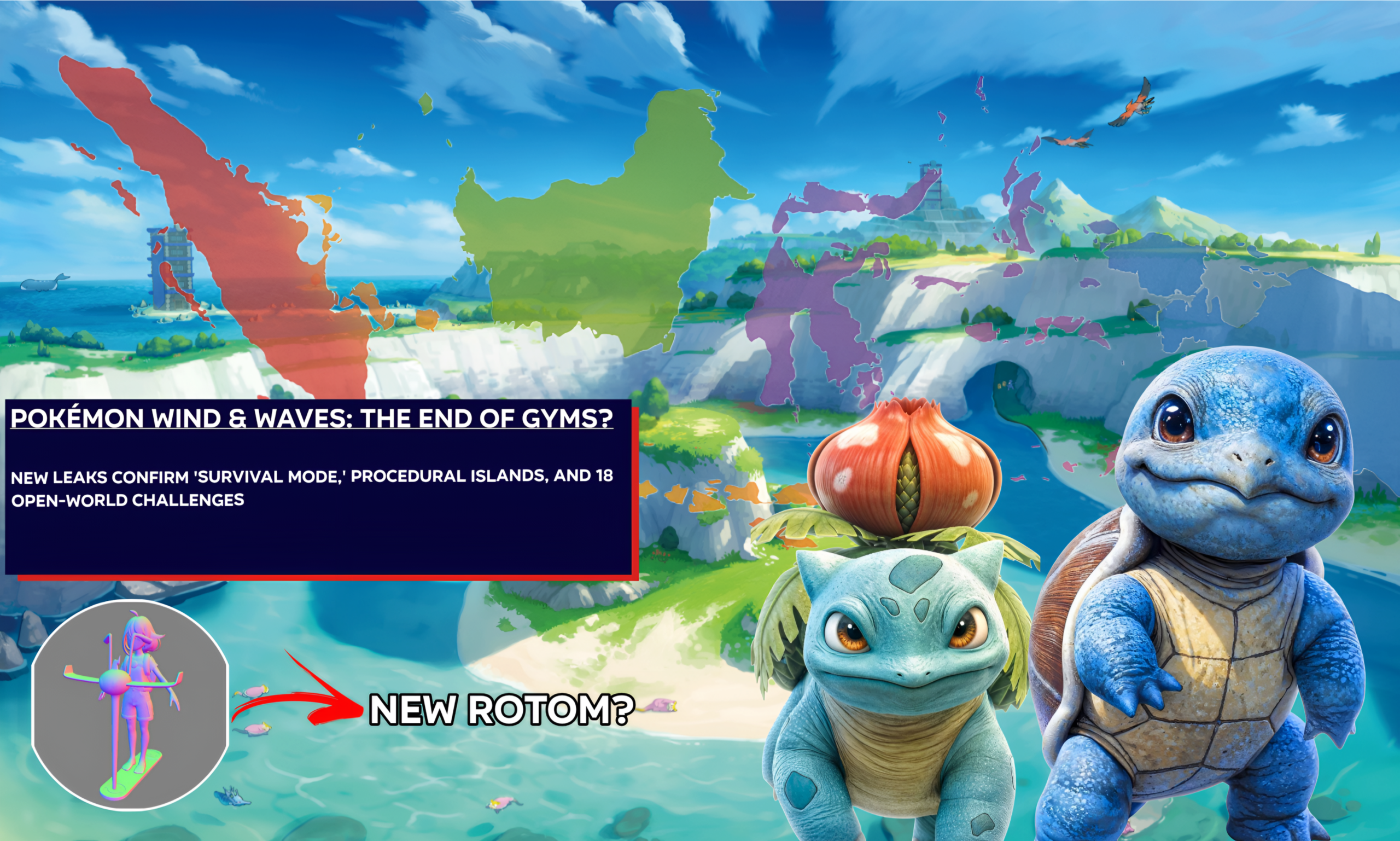
Recent intelligence gathered from the massive “Teraleak” data breach has pulled back the curtain on what is coming next. The files codify the tenth generation as “Project Gaia,” tentatively titled Pokémon Wind and Pokémon Waves. These are not merely sequels. They represent a fundamental restructuring of the Pokémon RPG formula. We are looking at a strategic pivot toward a semi-procedural, open-world architecture powered by a proprietary new engine. The stakes have never been higher. Following the technical stumbles of Generation 9, the creators are betting everything on a concept they call “Infinity”.
This is the moment the franchise grows up. We are moving away from the safety of the past and into a future defined by seamless oceans, infinite variations, and a narrative that dares to tackle real-world environmental anxiety. If you felt the magic was fading, look closer at the horizon.
Here are eight massive reasons why Generation 10 promises to be the revolution we have been waiting for:
1. The End of Technical Debt and the Rise of Pokémon Engine X
The technical state of Pokémon Scarlet and Violet left scars on the community. The ambition was there, but the infrastructure crumbled under the weight of an open world it wasn’t built to handle. That era is over. One of the most significant revelations from the leaks is the retirement of that legacy engine. Generation 10 is being built on “Pokémon Engine X,” a new proprietary framework designed specifically for next-generation hardware.
This matters because it is not just about better graphics, it is about fundamental physics. The engine’s primary focus is environmental physics. In a game titled Waves, the ocean is no longer a flat, blue texture you surf across. It is a physical volume that interacts with the player and the Pokémon. We are talking about fluid dynamics where waves propagate realistically, tides shift, and light refracts underwater. Imagine battling on a shoreline where the tide actually comes in, altering the battlefield mid-fight. That is the promise of Engine X.
The “Wind” component is equally transformative. A global wind system will affect foliage, ballistics in battle, and even your traversal mechanics. Gliding isn’t just a static speed boost anymore, you have to read and learn environmental cues and catch currents. This engine supports world partitioning similar to Unreal Engine 5, which allows the game to stream vast archipelagos without loading screens. The stuttering and pop-in that plagued Paldea should be a memory. This is the technical infrastructure required to make the world feel alive rather than just a backdrop.
2. A True Open Ocean in a Southeast Asian Archipelago
We have traveled through regions inspired by France, Hawaii, the UK, and Spain. Now, the geographic focus shifts to Southeast Asia, with design documents explicitly citing Indonesia and Malaysia as primary inspirations. This is a massive departure from the contiguous landmasses of the past. The region is a fractured collection of islands separated by a vast, explorable ocean.
Think back to the sense of freedom in The Legend of Zelda: The Wind Waker. That is the core gameplay pillar here. The journey between islands is will not relying on fast-travel loading screen, you must embrace the adventure yourself. You no longer just walking from Route 1 to Route 2, you are navigating an open sea that feels dangerous and expansive. The “Open Sea” concept fundamentally changes the pacing of the adventure.
This setting also subverts the traditional “small town” beginning. You don’t start in a sleepy hamlet. The protagonist begins their journey in a metropolis modeled after Kuala Lumpur, characterized by skyscrapers, monorails, and high population density. You are established as a “City Kid,” an outsider to the natural world you are about to explore. This narrative choice is brilliant because it align well with the player’s mindset while playing the protagonist’s. We are tourists in this wild archipelago, overwhelmed by the verticality of the city and the vastness of the ocean. It brings a freshness to the exploration that has been missing for years
3. The “Infinity” Concept and Procedural Generation
Perhaps the most ambitious aspect of Project Gaia is the theme of “Infinity”. Game Freak is attempting to create a “forever game” that extends player engagement well beyond the traditional narrative conclusion. This is achieved through a semi-procedural world architecture. The game world consists of “Fixed Islands,” which contain the story-critical locations, and “Floating Islands,” which are procedurally generated.
Unlike games that generate worlds from pure noise, this appears to use a module-based system where the engine assembles islands from a library of biome assets. This means your map will look different from your friend’s map. The engine generates a unique “seed” for each island, which can be registered to a server and shared. You could discover a particularly rare island configuration rich in resources and share that code with the community, creating a massive, player-driven atlas of the archipelago.
This “Infinite Land” concept ensures that the map theoretically never ends or repeats. It addresses the complaint that once you beat the Champion, the world feels empty. Here, there is always another island on the horizon, another configuration to explore. It brings a roguelike element to the Pokémon formula, encouraging replayability and constant discovery. The ambition here is staggering, aiming to leverage the Switch 2’s processing capabilities to generate geometry in real-time.
4. The Seed Pokémon: A Partner Unique to You
The “Infinity” theme extends to the creatures themselves. The leaks detail a radical new mechanic called the “Seed Pokémon”. This is a new species, distinct from the traditional starters, given to you early in the narrative. While the base form is identical for everyone, its evolution is procedurally generated based on hidden values. This is where the game gets personal. Factors influencing the evolution include your training data, the locations you visit, and the biome where it evolves.
Leaks claim there are over 100 forms or potentially infinite algorithmic variations featuring unique fractal patterns and color palettes. It creates a symbiotic loop. The way you raise your Pokémon determines the world you explore, and the world you explore determines how your Pokémon evolves.
The narrative weight of this mechanic is immense. This creature is the key to unlocking the Legendaries, who will only accept a trainer who has “properly raised” a Seed Pokémon. It moves beyond the binary of “strong” or “weak” Pokémon. This is about your Pokémon. It mirrors the chaotic beauty of nature itself. Two players could stand side by side with the “same” species, yet their partners would look and behave completely differently based on their unique journeys. It revitalizes the bond between trainer and Pokémon, making it feel organic rather than programmed.
5. Integrating Survival Elements and the Jungle Frontier
For the first time in the mainline series, the tropical jungle is a primary biome, and it is not just for show. The leaked documents emphasize “Jungle Survival” as a key theme. These environments are dense and hostile, requiring players to use survival mechanics to traverse them. This shifts the tone from a leisurely route walk to a true expedition.
“Pokémon Survival” is listed as a core feature. While we aren’t expecting the hardcore punishment of dedicated survival simulators, the game includes resource management elements. You may need to gather ingredients for food, manage stamina while diving, and craft tools for traversal. This adds a layer of friction to the world that makes the exploration feel earned. You aren’t just walking through tall grass; you are navigating a living ecosystem.
This is supported by the character of the “Survival Professor.” At just 21 years old, he is a peer rather than an elder, and ironically, his book smarts often fail him in the wild. He relies on the player and the local Rival to survive. It deconstructs the usual power dynamic where the Professor knows everything. Here, you are learning together. It makes the world feel dangerous and untamed, a place that requires respect rather than just conquest.
6. Tenko-Waza: Weaponizing the Weather
Combat is getting a shake-up with the introduction of “Tenko-Waza,” translated as “Weather Moves” or “Weather Arts”. This is the defining gimmick of Generation 10, replacing Terastallization and Dynamax. Rather than changing a Pokémon’s type or size, this mechanic allows them to manipulate the battlefield’s weather directly.
Imagine a Pokémon using a Tenko-Waza to summon a “Great Storm” that buffs Wind-type moves and debuffs flying opponents, or a “Tidal Surge” that floods the field. This introduces a layer of strategic environmental control. You aren’t just hitting the opponent; you are changing the conditions of the fight. These moves are unlocked through specific quests at elemental shrines, suggesting a progression system that is tied to exploration.
This aligns perfectly with the “Wind and Waves” theme. Mastery over the environment is mastery over the battle. It also hints at a deeper integration with the “Majin” or boss Pokémon, who are described as possessing god-like elemental powers. The leaks even mention testing a hybrid combat system that might blend action elements with traditional turn-based command, particularly for these large-scale boss encounters. It suggests a metagame that is dynamic and reactive, forcing players to adapt to shifting storms and tides.
7. A Mature Narrative: Corporate Villains and Real-World Ethics
The story of Wind and Waves signals a significant maturation of the franchise’s storytelling. The antagonists are no longer cartoonish villains seeking world domination. The “Land Development Team” represents a shift towards grounded, sociological villains. They are corporate entities driven by profit and environmental apathy. They destroy ecosystems not because they hate nature, but because they are paid a salary to do so.
This portrayal of “corporate banality” is a sharp critique of modern capitalism. The conflict revolves around “Generational Stewardship.” The story asks whether the current generation is preserving or destroying the world for the next. This is personified by the protagonist’s infant sibling. You have a baby brother or sister who begins the game helpless, unable to walk or talk. As you progress, the baby grows, tracking your emotional investment in saving the world. You are fighting to ensure a future for this child.
The game also integrates the United Nations’ Sustainable Development Goals (SDGs) into the core gameplay loop. Traditional Gyms are replaced by 18 “Challenges,” each thematically resonant with a specific Pokémon type and an SDG. An Electric Challenge might relate to clean energy, while a Water Challenge focuses on ocean conservation. It grounds the fantasy in reality, giving the challenges a sense of moral purpose that collecting badges never had.
8. Paving the Way for the Future: The MMO Connection
The story of Wind and Waves signals a significant maturation of the franchise’s storytelling. The antagonists are no longer cartoonish villains seeking world domination. The “Land Development Team” represents a shift towards grounded, sociological villains. They are corporate entities driven by profit and environmental apathy. They destroy ecosystems not because they hate nature, but because they are paid a salary to do so.
This portrayal of “corporate banality” is a sharp critique of modern capitalism. The conflict revolves around “Generational Stewardship.” The story asks whether the current generation is preserving or destroying the world for the next. This is personified by the protagonist’s infant sibling. You have a baby brother or sister who begins the game helpless, unable to walk or talk. As you progress, the baby grows, tracking your emotional investment in saving the world. You are fighting to ensure a future for this child.
The game also integrates the United Nations’ Sustainable Development Goals (SDGs) into the core gameplay loop. Traditional Gyms are replaced by 18 “Challenges,” each thematically resonant with a specific Pokémon type and an SDG. An Electric Challenge might relate to clean energy, while a Water Challenge focuses on ocean conservation. It grounds the fantasy in reality, giving the challenges a sense of moral purpose that collecting badges never had.