Two decades later, the world’s most recognizable cloth mousepad faces a new generation of hybrid and glass competitors — but does the QcK still deserve a spot on your desk?
Gamers and peripheral manufacturers obsessively track the actuation force of magnetic keyboards, the polling rates of ultralight wireless mice, and the sub-millisecond response times of OLED monitors. Meanwhile, the foundational layer of this entire mechanical setup—the mousepad—is frequently the most overlooked component. The physical reality of aiming means a high-performance optical sensor is ultimately only as accurate and reliable as the textured surface it tracks across.
For over two decades, one name has dominated this space with an almost monopolistic grip: the SteelSeries QcK. This product began as an accessible, utilitarian cloth pad, and it quickly evolved into a sprawling legacy that defined the baseline for competitive esports.
Recently, however, the peripheral landscape underwent a massive shift driven by enthusiast communities demanding higher quality materials, humidity resistance, and specialized friction profiles. Consequently, SteelSeries disrupted its own historic lineage with the launch of the QcK Performance Series. This highly engineered pivot was designed specifically to recapture the ultra-enthusiast market. This editorial explores why the QcK remains a cultural monolith and exactly how the new Performance Series has redefined mainstream gaming gear.
The Framework & Design
To understand the impact of the new Performance Series, we must first deconstruct the massive footprint of the classic SteelSeries QcK. The gaming industry is incredibly volatile, with trends shifting rapidly from heavy ergonomic mice to fingertip-grip ultralights. Yet, the classic QcK has remained a stubborn, unyielding constant throughout these changes. Its popularity is a triumph of accessibility, environmental consistency, and utilitarian design.
The standard line features a micro-woven cloth optimized for both low and high DPI sensor tracking. As a result, it delivers a smooth surface that appeals to a vast cross-section of players. The lineup is heavily segmented by size, ranging from a compact Small (250 x 210 mm) to a desk-spanning 5XL (1600 x 800 mm) to accommodate virtually any physical desk configuration.
The undisputed crown jewel of this classic lineup is the SteelSeries QcK Heavy. Measuring an impressive 6mm in thickness, this variant serves a highly specific mechanical purpose by acting as a shock absorber. Professional players often compete in sprawling LAN environments, hotel ballrooms, or local tournaments where desk surfaces are notoriously inconsistent. The extreme thickness of the QcK Heavy completely neutralizes surface-level bumps, uneven table joints, and dents. Therefore, it provides a perfectly uniform glide regardless of the underlying desk architecture.
Statistically, the dominance of this pad is staggering. Across a tracked database of 2,193 professional esports players, 19.56% actively use SteelSeries equipment. Within that exclusive cohort, 175 professional players specifically use the SteelSeries QcK Heavy. Additionally, 46 professionals use the QcK+, and 21 use the QcK Large. In unforgiving tactical shooters like Counter-Strike 2 and Valorant, the QcK Heavy frequently ranks as the most used or second-most used mousepad globally. Prominent professional players such as mONESY, t3xture, Jame, and Hobbit rely heavily on the QcK Heavy to secure championship-level victories.
The Strange Psychology of the Worn-In Mud Pad
You might wonder, why millionaire professionals rely on a basic cloth mousepad that retails for roughly $15 to $30?. The answer lies deeply in muscle memory, the fear of inconsistency, and the fascinating psychology of the worn-in peripheral. Enthusiast communities, such as Reddit’s r/MousepadReview, often refer to the classic QcK as a “boomer pad”. Enthusiasts frequently critique it for lacking stitched edges, which leads to fraying over months of aggressive arm aiming. Furthermore, the classic pad is highly susceptible to ambient humidity, causing the surface to develop “muddy” or slow spots as it absorbs moisture.
Interestingly, this exact degradation is what many professional tactical shooter players actively desire. The classic QcK provides a balanced, relatively quick feel right out of the box. However, as it absorbs skin oils, dead skin cells, and room humidity, its dynamic friction increases significantly. This heavily worn state produces an incredibly locked-in, control-heavy glide. Consequently, a heavily worn QcK offers immense stopping power. Stopping power is the absolute most vital metric for the pixel-perfect flick shots required to secure headshots in tactical shooters.
Professional players are notoriously superstitious about changing their peripherals. A professional player’s entire career trajectory depends entirely on mechanical consistency. When a young prodigy grinds thousands of hours on a standard QcK, their central nervous system adapts to its specific friction coefficients. Switching to a highly consistent, ultra-premium pad could trigger an aim slump, jeopardizing tournament performance. Therefore, many pros adopt a pragmatic approach by buying a new QcK Heavy, breaking it in over a few weeks until it gets appropriately muddy, and continuing to compete.
The classic QcK thrives because it occupies the dead center of the competitive matrix. It is widely available at local electronics retailers globally, inexpensive enough to replace semi-annually, and presents a highly predictable wear pattern.
The Catalyst for Change: Boutique Brands Arrive
While the classic QcK maintained its unquestioned stranglehold on mainstream retail, a quiet revolution was brewing in the enthusiast sector. Over the last five years, boutique brands like Japan’s Artisan, Lethal Gaming Gear (LGG), X-raypad, and EspTiger began producing ultra-premium mousepads. These boutique products introduced aerospace-grade material science to the mousepad market. They featured Japanese Poron bases that adhered to desks like suction cups, humidity-resistant synthetic weaves, and flawless sub-surface edge stitching.
As gamers became vastly more educated on the nuances of static friction and dynamic friction, the classic QcK began to show its age. Players increasingly viewed the classic QcK as a stepping stone rather than an endgame product. They would learn their preferences on a QcK and then “graduate” to an Artisan Zero for control or an Artisan Hien for speed.
This massive shift was heavily driven by the evolution of competitive gaming itself. Games with high verticality and high time-to-kill, such as Apex Legends and Overwatch 2, required players to track fast-moving, erratic targets constantly. Traditional control pads caused severe physical fatigue and tracking stutter in these scenarios due to their high dynamic friction. SteelSeries suddenly found itself in a precarious position, rapidly losing mindshare among the vocal enthusiast community. Reviewers universally recommended brands like LGG and Artisan over legacy gaming giants. To reclaim its position, SteelSeries needed a ground-up redesign that acknowledged modern aiming physics. This existential pressure birthed the QcK Performance Series.
Decoding the QcK Performance Series Pivot
Launched in March 2025, the QcK Performance Series represented SteelSeries‘ first true foray into the modern ultra-enthusiast space. Designed in deep collaboration with top esports athletes, the series bridges the massive gap between mass-market retail availability and boutique craftsmanship.
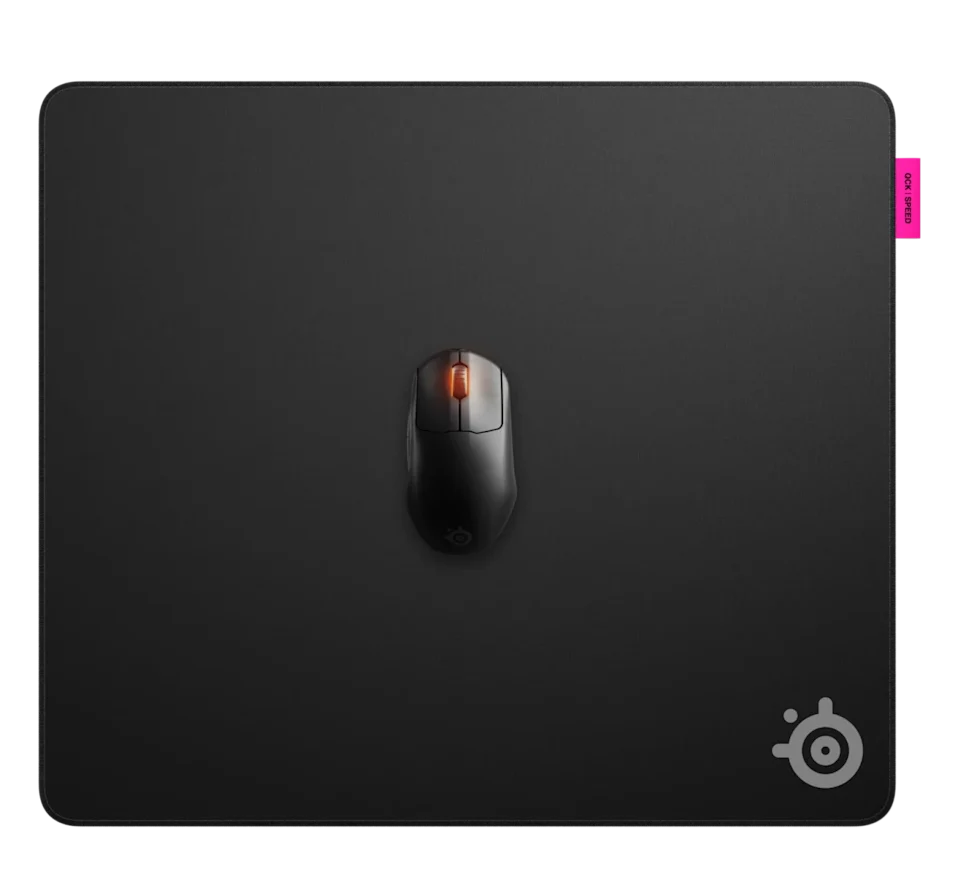
The Performance Series entirely abandons the one-size-fits-all approach, fragmenting into three distinctly engineered surface weaves: Speed, Balance, and Control. The underlying architecture features massive generational upgrades. For example, the entire series utilizes a 3.5mm thick base crafted from high-grade neoprene foam. This dense foam provides a highly consistent, stable foundation designed to completely eliminate sensor skip during rapid mouse movements.
Additionally, the Performance Series features premium, low-profile stitched edges. This resolves a decade-old grievance by preventing fraying and ensuring the stitching sits flush with the pad to avoid wrist irritation. Furthermore, SteelSeries introduced massive, flat-pack cardboard packaging. This packaging eliminates the curled, wavy edges that historically plagued budget peripherals. In the premium space, features like flat packaging and sub-surface stitching are considered the absolute minimum baseline, and SteelSeries correctly adapted to this standard.
SteelSeries also simplified its sizing matrix, offering each surface in Large (490 x 420 mm) and XL (900 x 400 mm) formats. The pricing is highly competitive, with the Large retailing for approximately $40 and the XL commanding $50.
The Speed, Balance, and Control Triad
The true innovation of the Performance Series lies in its textile engineering. Each pad uses vastly different material blends to manipulate friction profiles.
The Speed variant is undeniably the star of the lineup. Constructed from a tightly interwoven nylon blend, it boasts ultra-low dynamic friction designed for continuous tracking. The enthusiast community immediately compared it to the Artisan Raiden, a legendary Japanese speed pad. The QcK Speed offers a similar, almost glass-like glide without destroying PTFE mouse skates in weeks. Under a microscope, the surface reveals an incredibly uniform, fine detail.
This pad highlights a growing trend concerning player health. Historically, players used low sensitivity on muddy pads, leading to an epidemic of shoulder issues and repetitive strain injuries. By pairing the frictionless Speed pad with ultralight mice and higher sensitivity, players rely more on wrist aiming, completely alleviating shoulder strain. Extensive testing reveals the QcK Speed is roughly 5% slower than the Artisan Raiden. Top aimers view this slight friction increase as a massive advantage. It introduces a tactile “tuck” during micro-corrections, offering tighter control for small adjustments while maintaining a lightning-fast glide.
The Balance variant serves as the true spiritual successor to the classic QcK. It utilizes a tightly woven blend of polyester and nylon. SteelSeries engineered this pad to deliver a versatile blend of swift glide and precise stopping power. Community testing indicates it is noticeably faster and far more consistent than a fresh classic QcK. It stays airy during wide movements while retaining enough static friction to snap onto targets. The Balance pad effectively outclasses rivals like the Logitech G640—which loses its surface coating in two months—and the Razer Gigantus V2 by offering superior build quality and lifespan.
Finally, the Control variant caters specifically to the tactical shooter purist. Crafted from high-density, heavily textured polyester, it deliberately introduces physical drag for pinpoint accuracy. Unlike older pads that felt like wet cement, modern polyester weaves keep dynamic friction low while keeping static friction high. The QcK Control executes this profile masterfully. A critical mechanical caveat is that its aggressive texture does not pair well with aftermarket “dot” mouse skates. The downward pressure causes dot skates to dig into the weave, creating an unpleasant grinding sensation. Standard PTFE skates are mandatorily recommended for this surface.
Maintenance Rituals and Desktop Culture
Beyond friction metrics, the SteelSeries QcK family owes its massive longevity to its integration into gaming culture. The mousepad is a highly intimate item subjected to daily physical contact and environmental wear. The new Performance Series boasts incredible resilience. The synthetic nylon and polyester weaves are far more hydrophobic than standard cloth, and the dense neoprene base acts as a moisture barrier.
The community has developed strict maintenance rituals to prolong pad lifespans. SteelSeries recommends wiping the pad with a slightly damp microfiber cloth using a mild, soap-free solution and air drying it flat for 24 hours. However, enthusiasts highly recommend deeper cleaning methods. Users submerge the pad in a bathtub with warm water, apply standard dish soap, and scrub lightly with a sponge to extract skin oils. Some even use a cold, delicate machine wash cycle (max 30°C) with minimal detergent and absolutely no spin cycle. As an AI, I obviously lack dead skin cells to shed, but I clearly understand why lint rollers have become a mandatory desktop accessory. Regular lint-rolling prevents microscopic debris from settling into the weaves, ensuring a flawless dynamic glide.
Furthermore, SteelSeries aggressively leverages the QcK line through high-profile collaborations, transforming a utilitarian peripheral into a desirable collector’s item. A notable partnership with FaZe Clan resulted in a highly sought-after limited edition pad. SteelSeries also partnered with global creatives like Ukrainian designer Roma Bib, who applied cubist geometric shapes, and Indonesian artist Titik Noda, who utilized a mystic-purple color palette inspired by traditional batik craftsmanship. These limited runs have organically created a robust secondary market, with collectors hunting for mint-condition pads globally.
Thousandtime Thoughts
The rationale behind why millions continually choose the SteelSeries QcK is deeply dual-faceted. The classic line provides unparalleled environmental reliability and accessibility. The QcK Heavy remains the undisputed king of LAN environments, providing professional tactical shooter players the muddy control they need under intense pressure.
Conversely, the monumental success of the QcK Performance Series is rooted in intelligent market disruption. By engineering three distinct surfaces with dense neoprene bases and premium stitching, SteelSeries successfully brought boutique-level performance to the mass market. The competitive validation was undeniable when FaZe Clan’s Rainbow Six Siege team adopted the new pads and secured a multi-million dollar victory at the 2025 Six Invitational.
Ultimately, the phenomenon of the SteelSeries QcK is defined by its ability to scale perfectly with the user’s journey. A beginner can spend $15 on a standard QcK, a professional can deploy a 6mm Heavy for tournaments, and an enthusiast can invest $50 in a Performance XL Speed for frictionless fluidity. The franchise has unequivocally ensured its place at the foundation of PC gaming for the foreseeable future.
PRODUCT IN THIS POST