
Optillusion’s new survival-crafter traps players in a shifting architectural nightmare. Here is everything we know about how you’ll actually survive it.
Survival games usually begin with a tree. You punch it, you gather wood, you build a primitive box, and you slowly begin to conquer nature. The appeal lies in dominion—the fantasy of taking an untamed wilderness and bending it to your will.
But what happens when there is no nature to conquer? What happens when the world is not a forest waiting to be harvested, but a colossal, indifferent machine that actively hates you?
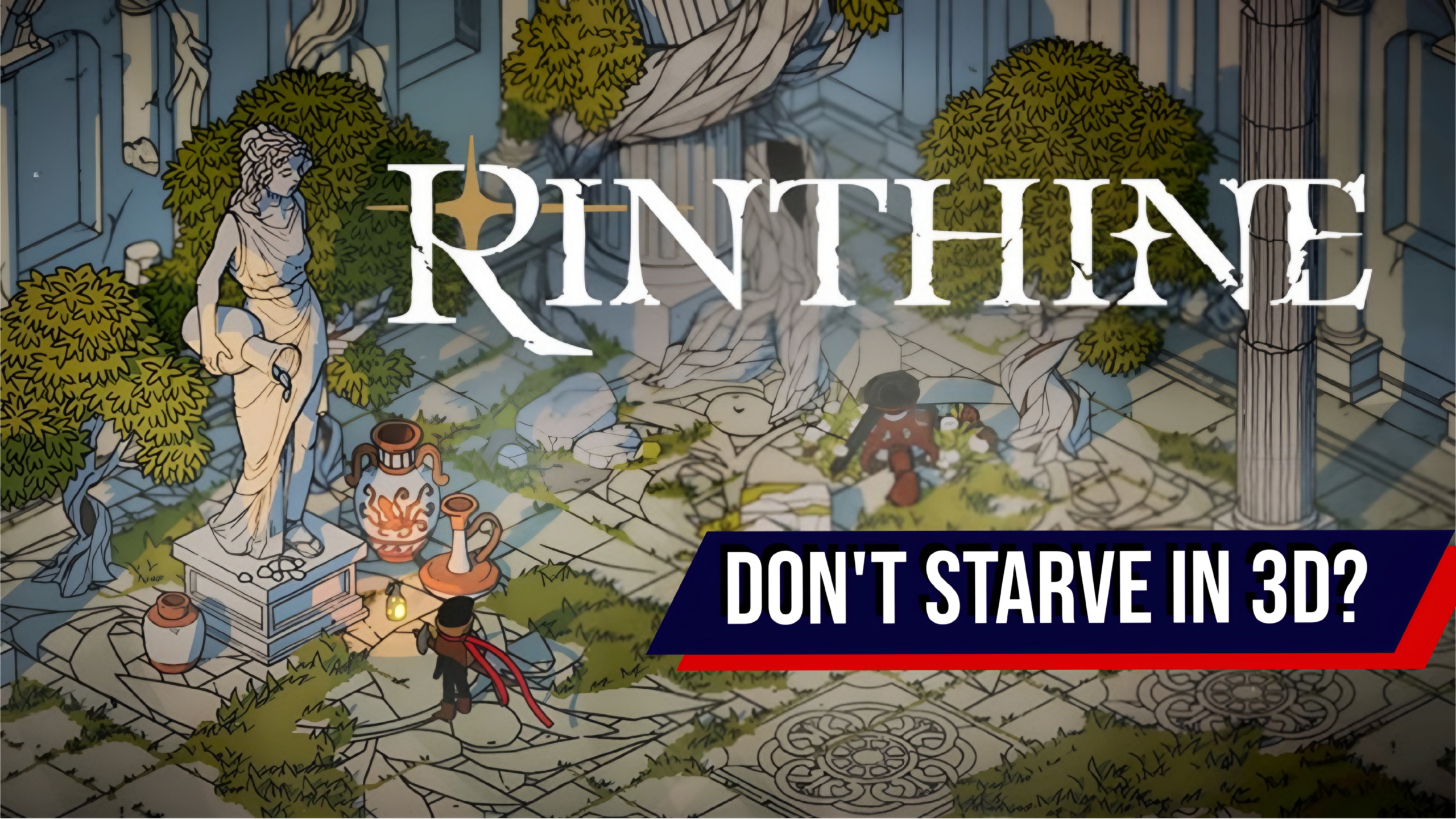
That is the premise at the heart of Optillusion’s newly revealed project. Known for their brilliant perspective-shifting puzzle game Moncage—a masterclass in spatial storytelling—the studio is pivoting hard with their March 2026 announcement. Rinthine drops you into the role of the Wayfinder, a cozy, hand-drawn 2D character, and traps you inside an oppressive, brutalist 3D labyrinth of crumbling ruins and endless stone halls.
Since the trailer dropped, fans have been obsessively dissecting the footage, trying to understand how the Rinthine game early access survival mechanics will actually function in a world devoid of dirt and sunlight. It is a jarring, brilliant aesthetic whiplash. The vibe is less “weekend camping trip” and more a psychological thriller. Imagine being trapped in the architectural nightmare of Susanna Clarke’s novel Piranesi, but bound by the unforgiving resource scarcity of an indie survival classic.
Navigating the Maze: How Building Works in Rinthine
In a traditional survival crafter, you clear a plot of land and impose your will on the environment. You chop down the forest to build the cabin. If you are wondering how building works in Rinthine, you have to discard the idea of terraforming entirely. You are not a colonist here; you are a parasite hiding inside a mechanism that was never meant to house you.
The labyrinth itself is procedurally generated. Its brutalist architecture stretches and contorts in unnatural ways, meaning you cannot rely on a static map or a comforting sense of direction. Because of this, you aren’t building a sprawling, multi-story base in a sunlit meadow. Instead, you are carving out temporary “safe rooms” within hostile, pre-built corridors.
Players must find structural alcoves—a dead end, a collapsed stairwell, a forgotten chamber—and fortify them. You board up doorways with scavenged scraps, reinforce crumbling stone walls, and desperately construct rudimentary workstations. The building system inherently reflects the game’s core claustrophobia. It is about barricading yourself against the unknown rather than expanding your territory.
The architecture feels intensely heavy. It towers over your small, delicate 2D character in a way that makes every constructed fire pit or storage chest feel pathetically fragile. You are merely claiming a tiny pocket of warmth in an endless ocean of cold stone. The aesthetic contrast isn’t just for show; it is a mechanical reminder of your vulnerability.
Fighting the Elements (and the Shadows)
The moment-to-moment survival loop maps familiar concepts—hunger, sanity, and combat—onto a surreal, deeply uncomfortable setting. But unlike standard survival titles where simple weather patterns dictate your daily routine, Rinthine introduces shifting “seasons” within the maze itself.
A corridor that was perfectly safe yesterday might become a flooded, impassable canal today, completely altering your traversal routes. A previously well-lit hall can suddenly plunge into a pitch-black cycle, forcing you to burn precious, finite resources just to see your own hands. We saw this in one of the most striking moments from the announcement trailer: a single torch illuminating a set of impossible, M.C. Escher-style staircases, casting long, terrifying shadows against the geometric walls.
You aren’t just managing a hunger meter; you are managing your psychological endurance. When you look at the grueling scarcity and the looming dread, it is easy to see why players are already drawing comparisons to games like Piranesi and Don’t Starve.
The maze demands absolute respect. Traditional survival games eventually let you out-level the danger, turning predators into farmable resources. Rinthine, however, seems designed to keep you permanently on the back foot. Every expedition for food or tools feels less like a routine farming run and more like a desperate, high-stakes heist against an ecosystem that wants to crush you.
Is Rinthine Multiplayer Co-Op? Surviving Together
Yes, and that inclusion drastically changes the psychological weight of the labyrinth. While Optillusion is keeping the exact technical details close to the chest ahead of a deeper gameplay showcase, the current roadmap for Early Access suggests small, intimate lobby sizes. This is likely designed for two to four players, fostering tense, shared survival rather than massive, server-wide chaos.
Shared base progression will be central to this co-op experience. You can easily imagine the emergent narratives: one Wayfinder stays behind to fortify a crumbling safe room and manage the dwindling food rations, while the others venture out into the shifting architecture to scavenge for tools.
But multiplayer in a procedural maze comes with its own unique terrors.
What happens when your team gets separated during a pitch-black cycle? What happens when the corridor you walked down together suddenly shifts, cutting off your escape route? In a forest, you can just tell your friend to meet you at the river. In the Machine, communication and spatial awareness will be just as critical as your inventory management.
As for when players can actually step into the labyrinth, Optillusion has slated the game as “coming soon” to PC via Steam. Given the polished, atmospheric state of the March reveal, the community is anticipating an Early Access launch sooner rather than later. Until then, we are left to study the trailer and prepare for a game where the map itself is the final boss.