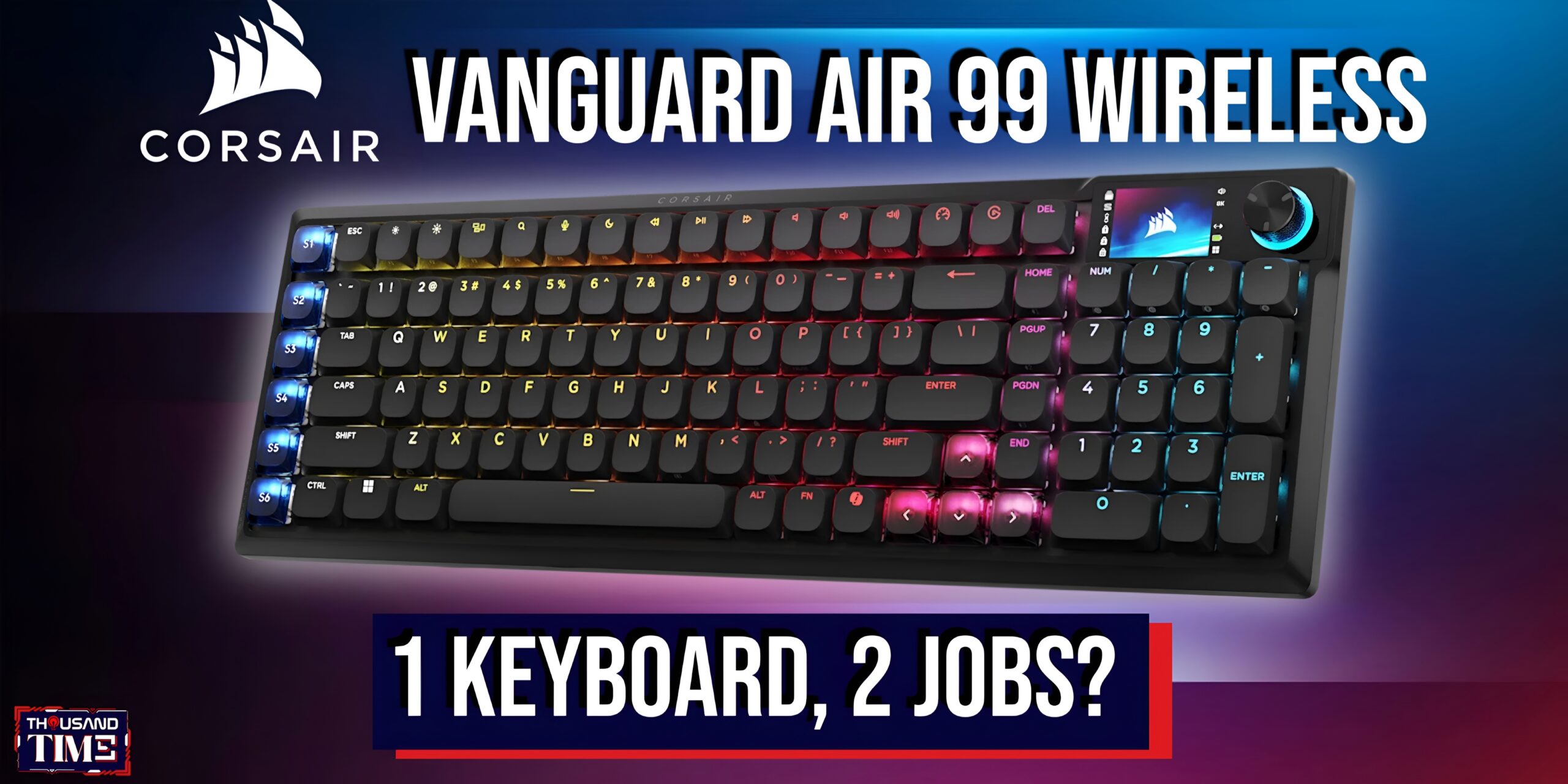
Corsair’s $259 low-profile Vanguard Air 99 packs 8,000Hz polling and built-in Elgato integration, but it might not be the complete command center it claims to be.
There is a particular kind of desk envy that exists almost exclusively online. You have seen it — the cable-managed, single-monitor, impossibly clean setup that somehow fits a mechanical keyboard, a Stream Deck, an audio interface, and a ring light into a space that looks like it belongs in an architecture magazine. The aesthetic is aspirational. The reality is that most people have two devices fighting for the same six inches of desk, and they are quietly annoyed about it.
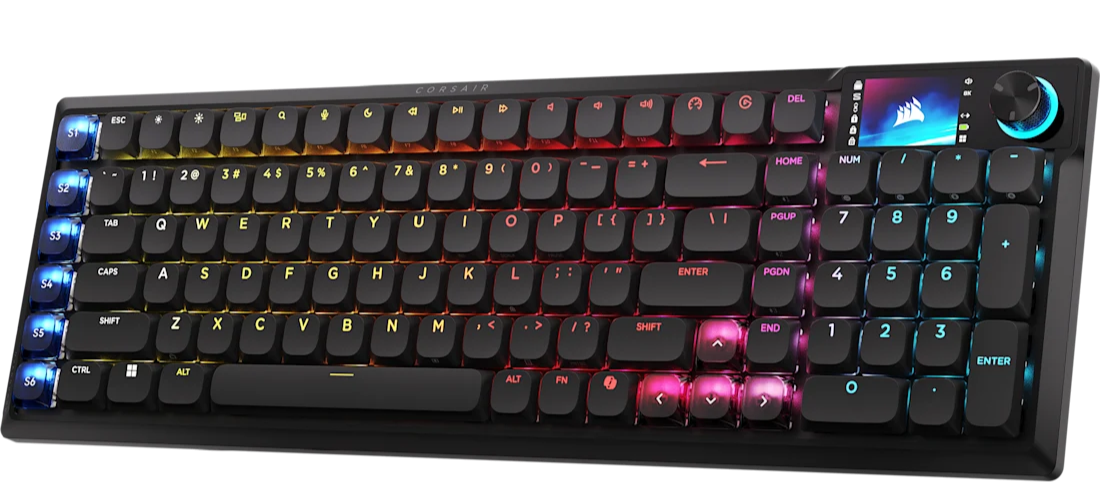
Corsair seems to have noticed. The Vanguard Air 99 Wireless — the successor to the K100 Air and the company’s most ambitious low-profile board to date — arrives at $259 with a pitch that is hard to ignore: a premium gaming keyboard with a physical LCD screen, native Elgato integration, and six programmable macro keys baked directly into the left column. The question worth asking honestly is whether the Vanguard Air 99 can actually replace a standalone Stream Deck, or whether it simply sits next to one while claiming otherwise.
One Device, Two Identities
The integration story starts with the S-keys — six dedicated keys running down the left side of the board that connect directly to the Elgato Stream Deck software. In practice, this means users can assign Stream Deck actions to physical keys without touching the app in real time. Scene switches, clip saves, mute toggles. The workflow works, and for light creator use it works well.
Then there is the 1.9-inch LCD screen embedded in the top-right corner of the board, alongside a multi-functional rotary dial. This is where the Vanguard Air 99 makes its boldest visual argument for desk consolidation. The screen displays live system stats, media playback information, and — through what Corsair calls the Virtual Stream Deck feature — a software-rendered replica of a Stream Deck interface.
The Virtual Stream Deck is a genuinely clever piece of software design. It pulls the full Elgato ecosystem into a single display without requiring a separate device. But here is the thing: the 1.9-inch screen is one screen. It shows one panel of information at a time, updated through software rather than hardware. A physical Stream Deck — the 15-key MK.2, for instance — gives every button its own individual LCD, each one independently lit, color-coded, and immediately readable at a glance across a desk. The Vanguard’s screen requires your eyes to find it, focus on it, and interpret it. That is a different interaction model, and for anyone managing a live stream with multiple scene layers and audio sources, that difference is not small.
The rotary dial is more universally useful. Volume, scroll, timeline scrubbing — it is the kind of control that earns its place without requiring justification. Small wins matter in a feature set this layered.
What Happens When You Actually Type on It
The Vanguard Air 99 ships with Corsair’s new OPX low-profile optical switches, actuating at 1.5mm with a light, linear feel that sits noticeably closer to the desk than most mechanical keyboards without feeling toy-like. Optical switches register via light beam rather than physical contact, which eliminates debounce delay and contributes to the board’s headline polling rate: 8,000Hz through Slipstream v2 wireless. That number — eight thousand position reports per second — is relevant primarily in competitive gaming contexts, where input latency margins are genuinely contested. For everyone else, it is a number that signals serious hardware intent.
The acoustic story here is worth noting because it represents a real step forward from the K100 Air. Corsair has implemented a gasket mount construction paired with five layers of sound-dampening foam, and the result is a noticeably softer, more settled typing sound. The K100 Air, built on Cherry MX Ultra Low-Profile switches, had a crisper and slightly harder acoustic character. The Vanguard’s profile is rounder — closer to what keyboard enthusiasts loosely describe as “thocky,” though applied to a slim form factor that most enthusiasts would not traditionally associate with that word. It is a quieter, more composed board, and that matters if this thing is going to sit next to a microphone.
FlashTap, Corsair’s SOCD (Simultaneous Opposing Cardinal Directions) implementation, rounds out the competitive feature set. Tactical shooter players who need clean, conflict-free movement inputs on WASD will find it works as advertised. It is a niche feature, but the players who need it know exactly why it is there.
Who Should Actually Buy This
The Vanguard Air 99 earns its price tag in a specific scenario: the hybrid desk. Someone who games competitively and creates content, who values wireless performance and minimal cable clutter, and who uses Stream Deck functions regularly but not at the level of a dedicated live streamer managing a professional broadcast. For that person — and there are genuinely a lot of them — this board consolidates two workflows into one device without catastrophic compromise on either side.
Professionals with multi-device setups will also find the board’s connectivity useful. The Vanguard supports Bluetooth alongside its Slipstream wireless receiver, which means switching between a gaming PC and a work laptop without disconnecting anything. The Web Hub integration extends this further, though as of this writing, full iCUE software support is still incoming via firmware update — something worth factoring into any purchase decision made right now.
Check out other keyboard review here: The Mountain Everest Max: Is This the End of the “Frankenstein” Desk Setup?
Who should skip it: heavy live-streamers who rely on constant, immediate visual feedback from their macro setup. If you are switching between eight scenes, managing alerts, running sound effects, and muting audio inputs mid-stream, the 1.9-inch screen is not a replacement for dedicated LCD keys. It is a supplement at best. A standalone Stream Deck remains the right tool for that workload, and no amount of software integration changes the physical reality of what one small screen can show you at once.
Budget-conscious buyers should also look elsewhere. At $259, the Vanguard Air 99 is priced alongside premium full-size keyboards that do not ask users to fund creator features they may rarely use. That is not an argument against the board — it is an argument for knowing what you are actually paying for.
Thousandtime Thoughts
The Vanguard Air 99 is part of a broader pattern in the peripheral market: manufacturers consolidating two premium devices into one and pricing the result close to both combined. The logic for the consumer is straightforward — fewer devices, less clutter, one ecosystem. The catch is that consolidation tends to produce one strong product and one compromised one, not two equally capable tools sharing a chassis.
This is not a criticism specific to Corsair. It applies across the category. When a single device attempts to serve two distinct professional use cases, the user often ends up paying full price for one and half price for the other. The $259 Vanguard Air 99 is close to being worth that number as a keyboard alone. The creator features add value — but not enough to retire a dedicated Stream Deck. The real question is not whether hardware consolidation is desirable. It clearly is. The question is at what price point it stops being a convenience and starts being a tax on features you will only ever use halfway.
PRODUCT IN THIS POST