The CES 2026 Wearables Landscape and the Paradigm of Pure Vibes
The consumer electronics industry has operated under a strict, unyielding orthodoxy for the better part of a decade. Manufacturers engaged in an escalating specifications race. They transformed wristwatches from simple notification delivery systems into highly complex, multi-sensor medical diagnostics and communication command centers. By 2026, the baseline expectation for a flagship smartwatch included high-luminosity emissive displays, electrocardiogram sensors, blood oxygen monitors, and cellular connectivity. This relentless pursuit of functional supremacy required a profound physical compromise. Devices became significantly thicker, heavier, and inherently less elegant.
The Consumer Electronics Show in January 2026 marked a pivotal inflection point in this historical trajectory. Core Devices unveiled the Pebble Round 2 and signaled a radical departure from the prevailing industry consensus. The brand aggressively prioritized aesthetic purity and physical comfort over raw computational power or biometric data collection.
The Heavy Toll of Biometric Bloat
The evolution of the smartwatch charted a gradual shift from a glanceable smartphone companion to an autonomous, health-focused micro-computer. The 2026 iterations of the Apple Watch and the Samsung Galaxy Watch perfectly exemplify the culmination of this trend. The Apple Watch Series 11 leans heavily into monitoring profound physiological conditions. Its dense feature set includes background AFib history tracking, blood oxygen app integration, continuous ECG monitoring, and advanced sleep apnea notifications.
Similarly, the Samsung Galaxy Watch 8 introduces highly complex health algorithms like “Vascular Load” monitoring. Samsung’s experimental feature requires users to wear the device to sleep for at least three days out of a fourteen-day period to measure cardiovascular stress and baseline health. Furthermore, Samsung’s devices utilize advanced Bioelectrical Impedance Analysis sensors to measure body composition. These features represent genuine triumphs of miniaturized medical engineering. They also inflict a severe physical toll on the hardware.
Integrating optical, electrical, and thermal sensor arrays requires significant z-axis volume. The sensors must maintain continuous, unbroken contact with the dermis to function accurately. This necessitates the creation of a protruding sensor dome on the rear of the watch chassis. This architectural necessity is colloquially referred to as biometric bloat. The modern smartwatch elevated by its sensor array rides high on the wrist, making it prone to catching on shirt cuffs and feeling unstable during rapid movement. Reviews of flagship devices in 2026 consistently note that models like the Samsung Galaxy Watch 8 Classic feel exceedingly bulky on the wrist.
Dimensional Obfuscation and the Illusion of Thinness
Manufacturers frequently engage in dimensional obfuscation to mask this added bulk. They report the thickness of the watch body while deliberately excluding the optical sensor array that rests against the skin. This creates a vast disparity between the claimed thickness on a specification sheet and the true thickness experienced by the wearer in three-dimensional space.
The standard Samsung Galaxy Watch 8 serves as the primary case study for this phenomenon. Official specifications released by Samsung list the standard Watch 8 at a remarkably thin 8.6mm. Yet independent pixel-peeping analysis of official side-profile imagery reveals a starkly different physical reality. When factoring in the protruding sensor array necessary for its advanced biometric features, the true thickness expands to approximately 11.7mm. The base chassis is indeed 8.6mm, but the health tracking protrusion adds over 3mm of depth.
This disparity becomes even more pronounced in the premium 46mm Samsung Galaxy Watch 8 Classic. Samsung officially lists the model at 10.6mm thick. Forensic estimates based on the underlying sensor hump place its actual footprint closer to 14.2mm. This represents a nearly 4mm deviation from the marketed specifications. Garmin embraces the massive footprint of its devices and engineers them unapologetically for extreme endurance. The Garmin Fenix 8 represents the absolute zenith of function-first engineering. The massive 51mm Solar model crests at 15.4mm thick and weighs an immense 95g without its strap.
Apple’s approach with the Series 11 reflects iterative architectural refinement rather than radical reinvention. Apple maintains a strict stated depth of 9.7mm across both the 42mm and 46mm configurations. Still, this measurement often minimizes the impact of the rear crystal sensor array, meaning the perceived thickness on the wrist is slightly greater.
The Aesthetics of Radical Restraint
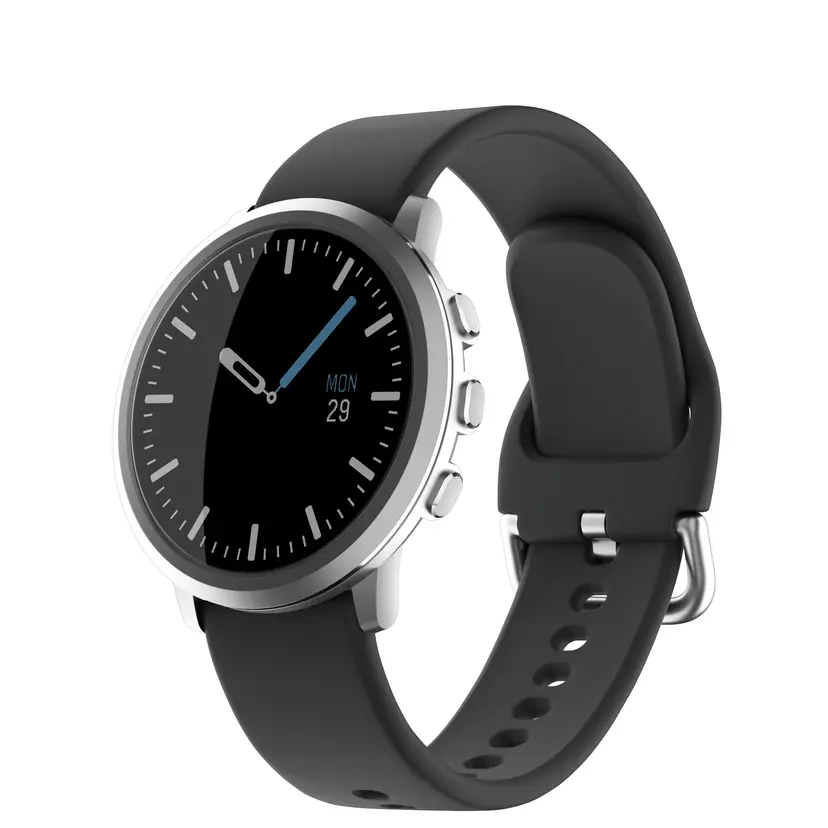
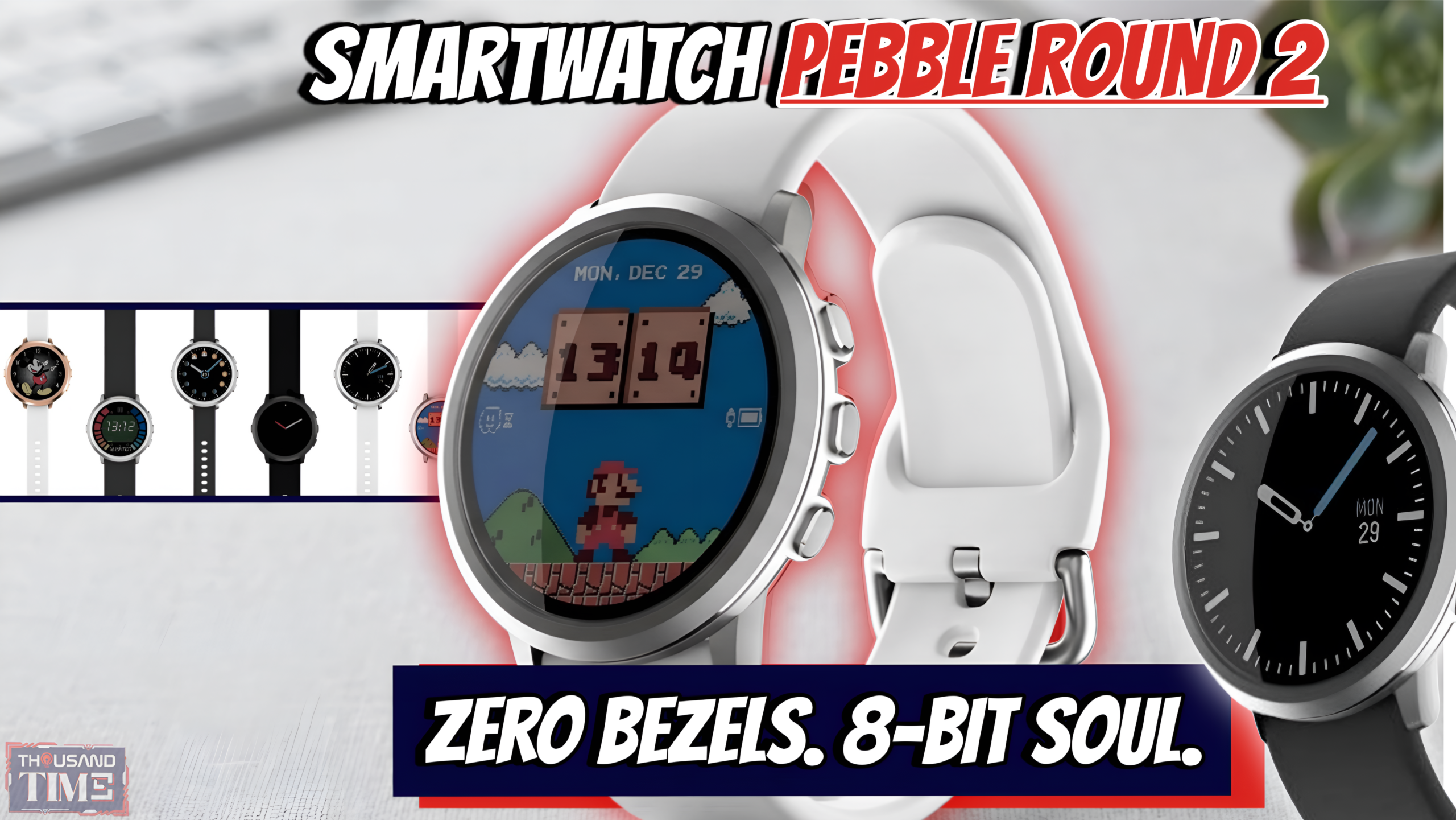
Against this backdrop of thick, sensor-laden devices, the Pebble Round 2 emerges as an exercise in radical restraint. Core Devices made the highly controversial decision to omit a heart rate monitor entirely. The watch relies solely on a 3-axis inertial measurement unit and a magnetometer to provide basic step tracking and rudimentary sleep tracking via movement analysis. This intentional hardware limitation allows the Pebble Round 2 to maintain a perfectly flat stainless steel caseback, enabling it to sit flush against the skin.
The device measures 41.5mm in diameter with a strict, uniform thickness of exactly 8.1mm. There is no hidden protrusion resting against the skin. The entire chassis is constructed exclusively from stainless steel and weighs a mere 26.8g without its strap. Reviewers and early adopters reported a mind-blowing sensation of comfort. The device sits so uniformly thin and flush against the wrist that it genuinely disappears from the wearer’s consciousness throughout the day.
Trend scanning of internet discourse on platforms like Reddit reveals a cultural pivot. A vocal subset of the consumer base views the lack of a heart rate monitor as a liberating feature. Users actively express fatigue over the anxiety-inducing nature of constant physiological surveillance. They argue that unless one is training for a specific athletic endeavor, the aesthetic benefits of a flat, thin watch far outweigh the data provided by an optical sensor.
E-Paper Dominance and “Pure Vibes”
The interaction between the user and the smartwatch is dictated almost entirely by the underlying display architecture. In 2026, the industry is overwhelmingly dominated by high-luminosity emissive displays. The Samsung Galaxy Watch 8 features a Super AMOLED screen capable of an astonishing peak brightness of 3,000 nits. The Apple Watch Series 11 utilizes high-resolution OLED technology. These emissive displays require substantial power delivery and dictate the inclusion of large batteries. The standard Galaxy Watch 8 struggles to exceed 30 to 40 hours of continuous use, requiring daily charging rituals.
The Pebble Round 2 completely bypasses this dynamic by deploying a transreflective 1.3-inch color e-paper display utilizing Memory-in-Pixel technology. E-paper reflects ambient light rather than emitting its own. It mimics the appearance of physical pigment on paper or a painted analog watch dial. It does not cast an artificial glow in darkened rooms, allowing it to blend organically with traditional clothing and preventing it from becoming a social distraction. This drastically reduced power requirement allows the watch to achieve between 10 to 14 days of battery life on a single charge.
The Pebble Round 2 won the cultural conversation at CES 2026 by perfectly capturing the zeitgeist of “pure vibes”. This represents a collective consumer desire for digital minimalism, stylistic agency, and a rejection of biometric bloat.
Community Agency and the Index 01 Unbundling
A critical element of the Pebble Round 2’s fashion-first appeal is the unparalleled level of software customization enabled by its ecosystem. Core Devices operates the Pebble OS as a 100% open-source platform, supported by the community-driven rePebble infrastructure. This ecosystem relies on an incredibly active appstore containing over 15,000 legacy and modern watchfaces. For the Pebble user, the watchface is a digital garment.
The PONGWATCH watchface exemplifies the community’s desire for whimsy and social signaling. It features a continuous, automated game of the classic arcade title Pong running on the e-paper display. The score at the top serves as the digital clock, with paddles automatically adding points every minute. The transition to the new 1.3-inch display resolution also sparked fierce debate among purists who demanded visual perfection. The community rallied around native developer ports of data-dense faces like Dashboard, shunning OS-level auto-scaling. Meanwhile, the “killer app” Canvas for Pebble completely democratizes the design process. It allows individuals with absolutely zero coding experience to build entirely personalized interfaces directly on their connected smartphone. Core Devices also executed a brilliant ecosystem strategy to achieve this extreme minimalism.
They solved the hardware space issue by unbundling advanced microphones, speakers, and AI processing power from the wrist and moving them to the finger via the Pebble Index 01. The Index 01 is a $75 smart ring designed explicitly as an external memory for your brain. It contains zero health sensors. It consists solely of a physical button, a microphone, a Bluetooth chip, and a battery. Users press the button to record voice notes, which are processed by an on-device Large Language Model housed within the smartphone app. The AI transcribes the audio and pushes silent reminders to the Pebble Round 2 display. This unbundling of features prevents the watch from becoming bloated with extraneous hardware. It serves as the ultimate realization of intentional, aesthetically driven tech integration.
Thousandtime Thoughts
The tech world has a stubborn habit of confusing sheer capability with everyday necessity. For years, massive corporations have operated under the assumption that our wrists need to double as clinical diagnostic centers and hyper-active smartphone replacements. The Pebble Round 2 proves that a significant portion of the public simply wants a beautiful, reliable watch.
It is incredibly refreshing to see a company look at the sprawling feature lists of the Apple Watch or Galaxy Watch and just walk away from the arms race. Dropping the heart rate monitor was a massive hardware gamble, but it paid off by delivering a level of physical comfort and aesthetic grace that the big players fundamentally cannot achieve right now. The true brilliance lies in offloading the heavy lifting of voice assistants to the Index 01 ring. Pebble managed to keep the watch remarkably thin while still feeling effortlessly modern. We are clearly entering an era where digital minimalism isn’t just a niche internet philosophy. It is a highly viable, highly desirable commercial reality.
PRODUCT IN THIS POST