
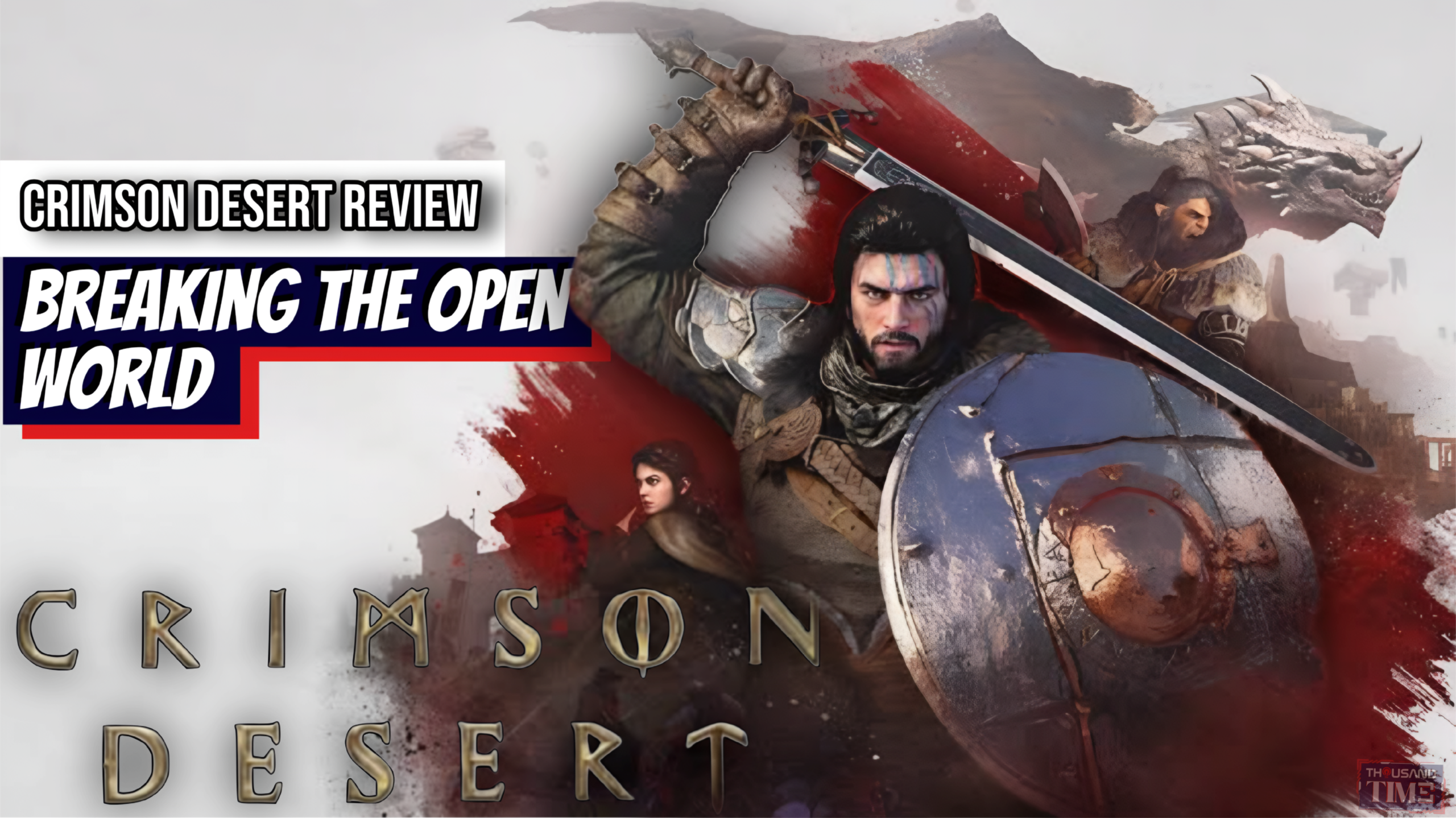
Pearl Abyss is throwing The Witcher 3, Dragon’s Dogma 2, and Devil May Cry into a blender. Here is why this madcap gamble could completely redefine the AAA action-RPG landscape in 2026.
Twenty-four hours before launch, the critical consensus surrounding Crimson Desert seems to have coalesced around a single, slightly panicked word: overwhelming.
It is a word that usually spells disaster for a modern video game. We have been conditioned to expect frictionless experiences, guided by glowing trails and neatly organized objective markers. We like our open worlds predictable. But as preview footage floods the internet and early impressions trickle in, it is becoming clear that Crimson Desert isn’t trying to safely iterate on the open-world formulas we’ve grown accustomed to. It is actively trying to break them by doing absolutely everything at once.
This is not a design flaw. It is a deliberate, chaotic choice. And it might be exactly the shock to the system the stagnant open-world genre desperately needs right now.
The “Everything, Everywhere” Approach to World-Building
Pearl Abyss is chasing the heavy, mature storytelling and intricate quest structures of The Witcher 3. It wants you to care about its protagonist, Macduff, and the grim, blood-soaked politics of Pywel.
But then, the game violently shifts gears into emergent madness. Crimson Desert channels the unpredictable, physics-based sandbox of Dragon’s Dogma 2. You don’t just swing a sword at a goblin; you can tackle it off a snowy cliff. You don’t just passively observe wildlife; you might find yourself in a desperate, rolling wrestling match with a bear. The environment is not a static backdrop. It is a weapon, a liability, and a deeply volatile participant in whatever you are trying to accomplish.
Finally, there is the combat. Rather than the floaty, stat-driven slashing typical of open-world RPGs in 2026, the combat sandbox leans hard into slick, combo-heavy mechanics that feel stripped straight from Devil May Cry. It is fast, kinetic, and demands high execution.
When you put these three pillars together, the result is deeply layered and incredibly friction-heavy. Crimson Desert refuses to let you zone out. You cannot clear out a bandit camp while listening to a podcast, navigating by a checklist of icons. The game demands your full, undivided attention, forcing you to constantly react to a world that feels aggressively alive.
Pearl Abyss is a studio built on the astronomical success of Black Desert Online, one of the most profitable MMORPGs on the planet. They had a formula that printed money. Transitioning from the infinite, microtransaction-fueled revenue stream of an MMO to a prestige, single-player narrative epic is an immense financial and creative risk.
So why do it? Because it is the ultimate flex.
If Crimson Desert succeeds, it proves that an MMO studio can cross the aisle and completely outplay legacy single-player developers at their own game. It is part of a larger, fascinating shift in the industry, where Asian developers are increasingly targeting and dominating the Western AAA market with high-fidelity, single-player action games. If Pearl Abyss lands this dismount, they don’t just get a hit game. They secure a seat at the table with the likes of Rockstar, Naughty Dog, and CD Projekt Red.
Will the Center Hold?
But ambition has a shadow, and its name is feature creep.
As the hype reaches a fever pitch, a valid counter-narrative is echoing through Reddit threads and enthusiast forums: Can a game simply be too dense?
Maximalist design sounds incredible on paper, but it is remarkably difficult to sustain. There is a very fine line between an engaging, reactive sandbox and exhausting, unreadable clutter. When a game offers deep narrative branches, complex fighting-game combos, parkour, physics-based grappling, and dynamic weather that actively alters gameplay, the physical act of playing can become a chore.
The primary concerns lie in the UI, the control scheme, and the pacing. Can a standard controller map all of these inputs intuitively? Can a human brain process the sheer amount of visual and mechanical information Crimson Desert throws at it for a 60-plus hour campaign without burning out? We have spent a decade complaining that open-world games are too simple, too hollow, too repetitive. Now, we are about to find out what happens when a developer gives us exactly what we asked for, with the dial snapped off at eleven.
Whether Crimson Desert lands as a flawless masterpiece or a beautiful, chaotic mess almost doesn’t matter. It is undeniably the boldest swing of the year. The only question left is whether you are ready for an RPG that demands this much of you, or if you prefer your open worlds just a little more streamlined.