
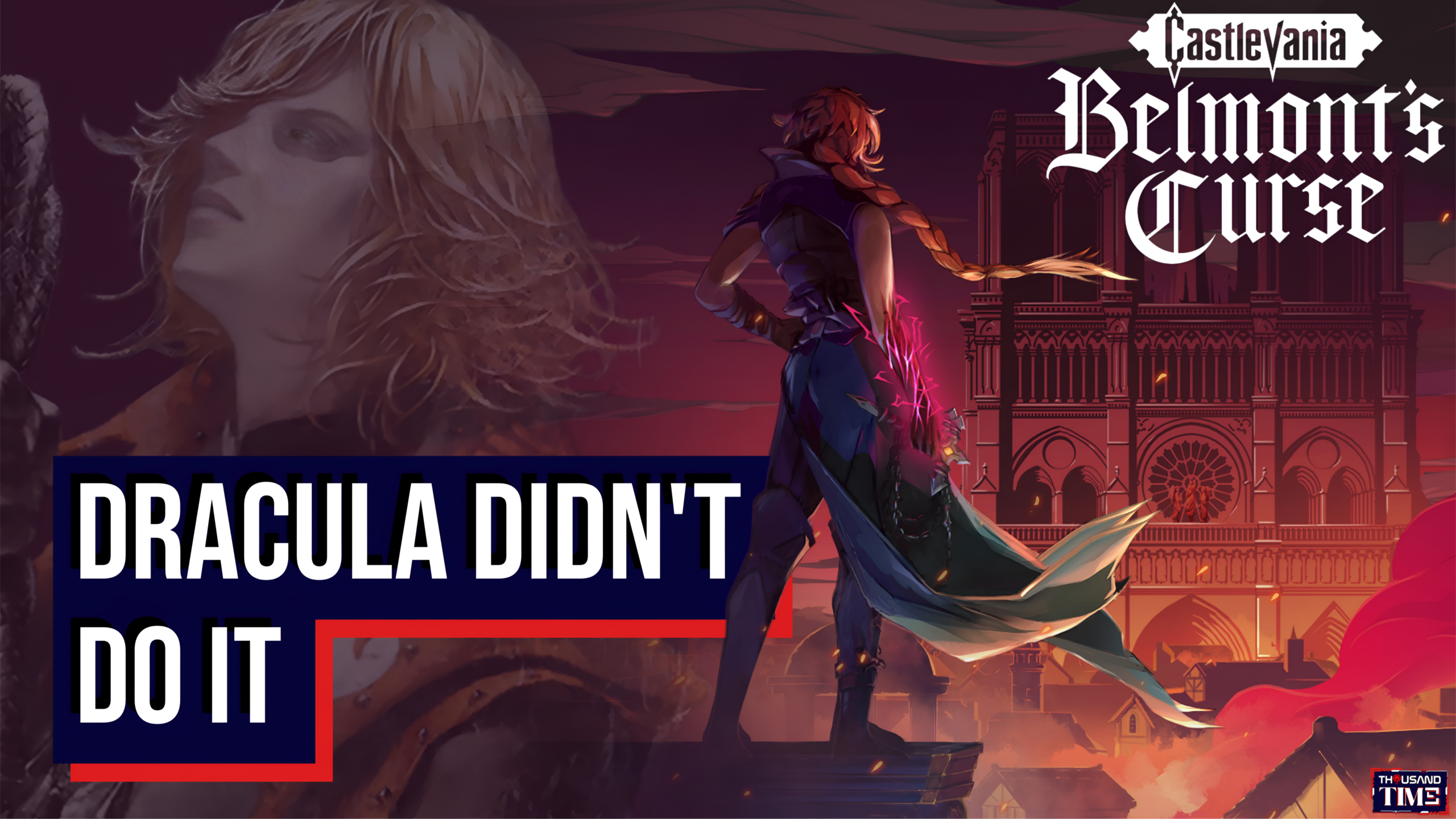
The new game has people talking. But the title is carrying a secret that most players are walking right past.
When Konami dropped the Castlevania: Belmont’s Curse announcement during February’s PlayStation State of Play, the response was immediate and loud. Twelve years since the last mainline entry. The first traditional 2D installment in the original timeline since 2008. Evil Empire and Motion Twin — the studio that made Dead Cells one of the best action games of the last decade — now bringing the gothic franchise roaring back to life. There was a lot to unpack, and most of the conversation understandably landed on what the game is: a Metroidvania set in 15th-century Paris, a burning city, an heir to the Vampire Killer whip, a potentially corrupted Joan of Arc.
What most of that conversation missed was the two words sitting right there in the title.
The Belmont’s Curse isn’t just a dramatic subtitle. It’s a specific thing — a moment, an event, a self-inflicted wound that sits at the foundation of this entire franchise. And to understand why that title matters, you have to travel back not to 1499 Paris, but to 1094 AD. To a knight named Leon. And to a vow made in grief that he had no right to make on behalf of everyone who would come after him.
The Cozy Void Nobody Was Filling
Belmont’s Curse is set 23 years after Castlevania III: Dracula’s Curse, GameTyrant placing it in the late 15th century — a period already carrying enormous narrative weight in the franchise’s history. The game drops the player into 1499 Paris, a city under siege from creatures that have emerged from the shadows, and tasks Trevor Belmont’s successor with entering the burning streets — armed with the legendary Vampire Killer whip — to hunt the beasts down. PlayStation
That successor is speculated to be Sonia Belmont, reintroduced here as Trevor’s daughter GameTyrant — a character who carries the same weapon, the same name, and the full weight of everything that name has meant for over four hundred years of in-universe history.
That last part is worth sitting with. This isn’t a protagonist who stumbled into monster hunting. This isn’t someone who volunteered. By the time the player takes control, the curse is already old. It was already old when Trevor fought Dracula in Wallachia. The decision was made centuries before anyone in the new game’s story was born — and it was made by a man who probably thought he was only speaking for himself.
1094 AD — The Night Leon Belmont Created the Curse
Castlevania: Lament of Innocence came out in 2003, and Koji Igarashi — then the franchise’s creative director and the architect of its modern canon — built it with a specific, deliberate purpose. He wanted to give the series an immovable beginning. Not a prequel as an afterthought, but a foundation. A first domino.
The setup is this: Leon Belmont is a nobleman and knight in 11th-century Europe. He’s successful, respected, engaged to a woman named Sara Trantoul. Then a vampire lord named Walter Bernhard kidnaps Sara, and Leon — stripped of his official title after abandoning his post to pursue her — goes after her alone.
What he finds at the end of that journey is worse than a vampire. His closest friend, Mathias Cronqvist, has been engineering the entire situation from the beginning. Mathias, consumed by grief over his own wife’s death and furious at what he sees as a God that abandoned him, has been manipulating events to acquire what he needs to transcend mortality. Sara, who has already been partially turned by Walter’s curse, sacrifices herself willingly — her soul bound into a whip that can harm even the most powerful of creatures. The Vampire Killer. The weapon that will pass through generations of Belmonts like a baton made of grief.
Mathias takes Walter’s power, completes his transformation, and becomes something that won’t have a name Leon recognizes yet — but history will know him as Dracula.
And Leon, standing in the ruins of everything he came to save, makes his vow.
“From this day on, the Belmont clan will hunt the night.”
It’s worth being precise about what that sentence is. It’s a grieving man, in a moment of rage and loss, deciding that his surname — and by extension everyone who will ever carry it — belongs to this fight. Forever. No consultation. No opt-out clause. Just the declaration of a man who lost everything that night and decided that loss would mean something, even if it had to mean something for people not yet born.
Igarashi designed Lament of Innocence to be exactly this: the canonical point of origin. The explanation for why a family of nobles became professional vampire hunters. The answer to a question the franchise had been asking implicitly for nearly two decades.
Why the 11th Century Matters in 15th-Century Paris
The protagonist picking up the Vampire Killer in 1499 Paris is carrying Sara Trantoul’s soul in their hands. Every crack of that whip is the echo of a sacrifice made four centuries earlier by someone the new Belmont never met. The weapon itself is the physical residue of the curse — not just metaphorically, but literally within the franchise’s lore. And the mission they’re on? It’s Leon’s mission, still running. Still unfinished.
The “curse” in the title isn’t really about monsters. It’s about inheritance. The Belmont family didn’t become vampire hunters because the universe chose them — they became vampire hunters because one of their ancestors decided, in a moment of pain, that this was what they would be. Every Belmont who followed — Simon, Trevor, Alucard’s half-siblings, Richter, all of them — has been living inside the consequences of that night.
By the time the protagonist of Belmont’s Curse enters the frame, the vow is 405 years old. Whatever personal story they carry into Paris — whatever they want, whatever they fear, whatever their relationship is to the Vampire Killer they wield — it exists within the walls Leon built in 1094. The question the new game seems quietly interested in is whether those walls can come down.
Or whether the only way out is to pass the whip to the next generation and let them carry it a little further.
The Weight of a Borrowed War
Belmont’s Curse marks the first traditional 2D installment in the series’ original timeline since Castlevania: Order of Ecclesia in 2008. Wikipedia That’s a long gap. And the franchise is returning not with a reboot or a reimagining, but with a direct sequel — one that trusts players to feel the accumulated history behind the title screen.
That’s a risk and a statement simultaneously. The game could have been called almost anything. Konami chose Belmont’s Curse. That choice is doing real work. It’s asking the player to understand that the protagonist isn’t just fighting monsters. They’re fighting an obligation they never agreed to, handed down through blood by someone who made a unilateral decision about what the family name would mean for the rest of time.
The new game is still a mystery in many ways — protagonist identity debated, story beats unpublished, release date unconfirmed beyond 2026. But the lore under it? That part isn’t complicated. The Belmont curse was created on a single night in 1094 by a man with nothing left to lose. Everything since has been the fallout.
If the new game’s protagonist finally breaks the cycle, it will be the most significant thing to happen to this franchise in decades. And if they don’t — if the whip passes again, as it always has — well. That might be the truer ending. The one Leon built into the vow without meaning to.