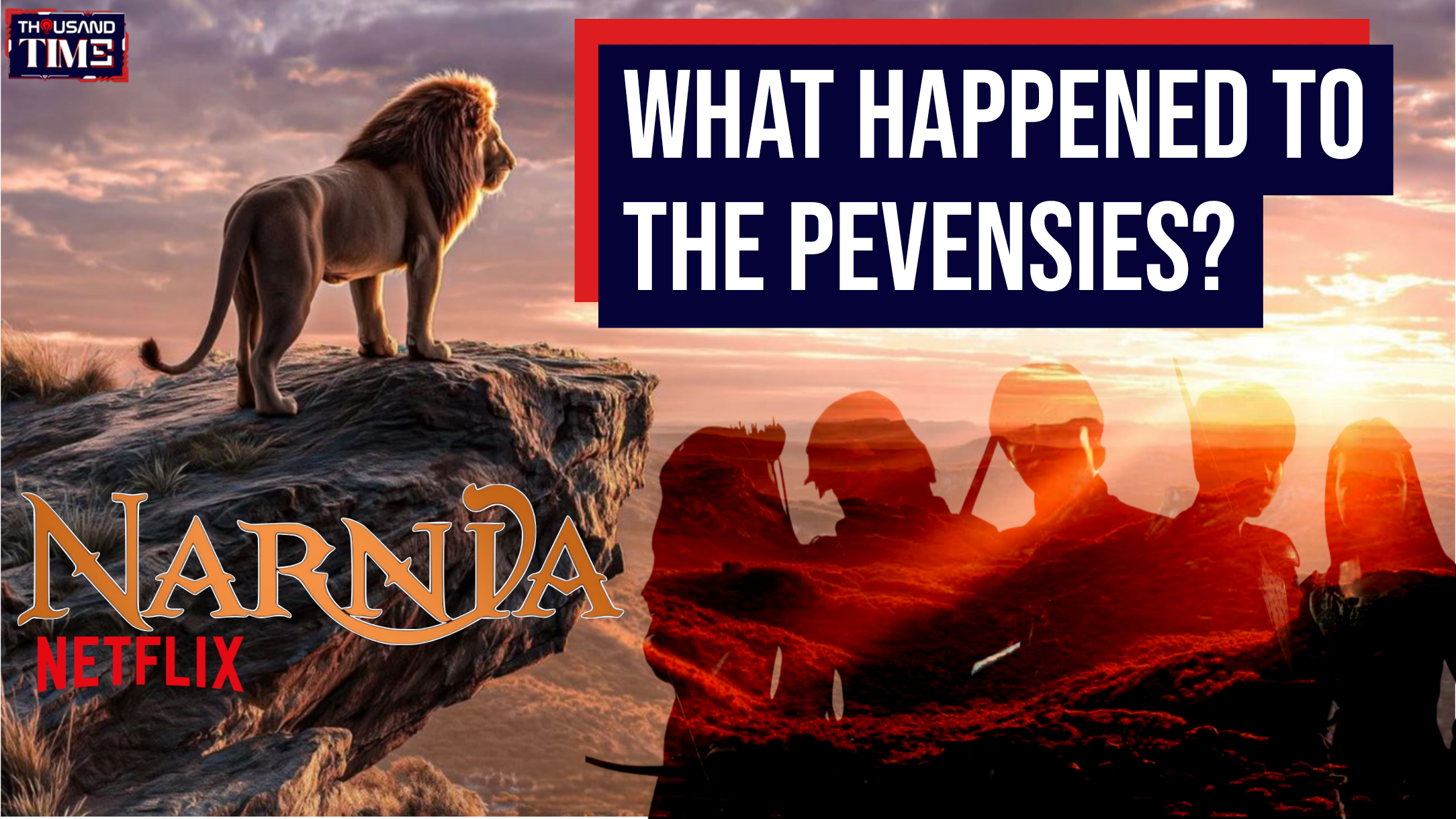
By anchoring the upcoming Netflix adaptations in mid-century Britain, the franchise isn’t just preserving C.S. Lewis’s timeline—it’s quietly solving the cinematic problem of what happens to Peter, Susan, Edmund, and Lucy next.
There’s a version of this Narnia reboot that doesn’t exist — and it’s worth pausing on. In it, the Pevensie children are teenagers in skinny jeans, sneaking through a wardrobe in some tastefully neutral contemporary bedroom. The talking animals speak in current slang. A TikTok reference lands somewhere around act two. It would have been a disaster. Not because modern audiences can’t handle fantasy, but because Narnia’s magic was never designed to exist outside the specific psychological wound of its historical moment.
The new Narnia movies, written and directed by Greta Gerwig and due to open in IMAX on Thanksgiving Day 2026, are not that version. Instead, the first film — an adaptation of The Magician’s Nephew — has been anchored firmly in 1955, in a Britain still visibly stitched together after the war. Set photos that emerged during production confirmed as much: grey streets, post-war reconstruction, a world still catching its breath. This is not aesthetic nostalgia. It is a precise creative argument about where Narnia’s meaning lives.
Why the 1950s Is Not Just a Backdrop
Gerwig’s decision to shift The Magician’s Nephew from its original Edwardian setting to 1955 is, at first glance, curious. The original novel is set around the turn of the century, when young Digory Kirke first witnesses Narnia’s creation. Moving it half a century forward disrupts the book’s internal timeline significantly. But it also does something narratively bolder: it pulls the entire cinematic universe into the same atmosphere that informed the Pevensie children’s story from the very beginning.
The Pevensies discovered Narnia during the Second World War, evacuated from London to the English countryside to escape the Blitz. That origin matters enormously. C.S. Lewis was writing about children who had been displaced, who had witnessed adult fear at its most raw, who were handed responsibility far beyond their years. The wardrobe was not simply a magical door. It was an escape from the specific, suffocating anxiety of mid-century British childhood. By keeping the Netflix universe rooted in that same post-war era — moving The Magician’s Nephew forward rather than setting the Pevensie chapters in the past — Gerwig is preserving something essential that earlier adaptations treated mostly as period detail.
This is the period of rationing, of reconstruction, of women who had run factories and hospitals during the war being quietly told the situation had changed and they should step back. It is a world of rigid order trying to reassert itself over an experience that had broken the old certainties. That tension — between magic and austerity, between the expansive inner life and the constrictive outer world — is the emotional engine of Lewis’s books. Without it, Narnia is just a fantasy kingdom with a lion.
The Pevensies: Legacy Characters or Tragic Figures?
The Magician’s Nephew is a prequel, and the Pevensie siblings won’t appear in Gerwig’s first film. That’s by design. Digory Kirke and Polly Plummer — played here by rising talents David McKenna and Beatrice Campbell — are the children at the centre of this chapter. But Digory, of course, becomes the Professor. The eccentric, knowing old man who owns the house. The wardrobe. The gateway.
You may wanna read our recent Narnia review here: Why Narnia’s Return Couldn’t Surpass Middle-earth
Which means that when Gerwig eventually arrives at The Lion, the Witch and the Wardrobe, she will be working with a Digory Kirke she has already built from scratch — one whose relationship with Narnia is personal history, not backstory. The Pevensie story, when it comes, will land in a world that has already been established with weight and interiority. Peter, Susan, Edmund, and Lucy won’t step into a convenient narrative device. They’ll step into something with its own emotional archaeology.
How that plays out on screen remains one of the genuinely fascinating open questions surrounding this franchise. The previous Walden Media adaptations handled the Pevensies primarily as adventure protagonists, aging actors creating the perennial problem of child stars outgrowing their roles. A mid-century anchoring, fully committed and cinematically realized, sidesteps that problem thoughtfully: it frames the children’s story as something that would always end, and frames that ending as meaningful rather than logistical.
Gerwig’s Period Setting as Feminist Grammar
There is another reading of this 1950s choice — one that would have been obvious to anyone who watched Barbie closely.
Greta Gerwig is not a director who sets films in particular historical periods for texture. She uses period as argument. In Little Women, she reconstructed Alcott’s timeline precisely because the structure of the story made a claim about women’s choices and their costs. In Barbie, the hermetically sealed fantasy world of Barbieland served as a lens through which contemporary gender expectations could be examined at full satirical resolution.
The 1950s are not a neutral backdrop. They are a decade that codified what a woman was supposed to want — domesticity, nylons, lipstick, the graceful acceptance of a narrowed life. Which brings us, inevitably, to Susan Pevensie.
Susan is the Narnia character that serious readers never quite stop thinking about. In The Last Battle, Lewis’s final novel, Susan is conspicuously absent from the heavenly reunion. She has, the other characters note, stopped believing. She is “no longer a friend of Narnia.” She is interested, apparently, in “nothing now-a-days except nylons and lipstick and invitations.” She has grown up. And in Lewis’s cosmology, that is presented as a kind of failure — a surrendering of imagination for the surface vanities of adult femininity.
It is one of the most contested passages in children’s literature. And it is set, without irony, against the symbols of 1950s womanhood.
By rooting this new cinematic universe in that same decade, Gerwig inherits the Susan problem — but she also inherits the tools to reframe it. A director who understands the coded violence of that era’s femininity, who has spent her career examining what happens when women are told their inner lives are less important than their social presentation, is not going to let Susan’s arc resolve the way Lewis resolved it. Or if she does, she will at least ask the audience to sit with what that resolution actually costs.
Thousandtime Thoughts
Modern fantasy adaptations often try to update themselves into relevance — new settings, contemporary slang, familiar anxieties in unfamiliar packaging. What Gerwig appears to understand, and what makes the 1950s setting so quietly radical, is that Narnia’s relevance is not a problem to solve. It is already there. It was written into the text by a man who had survived the First World War, watched a second one tear the world apart again, and wrote books for children about a magical kingdom that exists outside of time because — for children who had seen what the adult world could become — the need for that space was not metaphorical. The new Narnia movies don’t need updating. They need trusting.
FILM IN THIS POST
NARNIA: THE MAGICIAN NEPHEW
Content you might like after reading this
Insidious 6 Leaks: Why ‘Out…

Why Project Hail Mary is…

Hoppers Movie Review: Pixar’s Weirdest…
Why Season 3 is the…