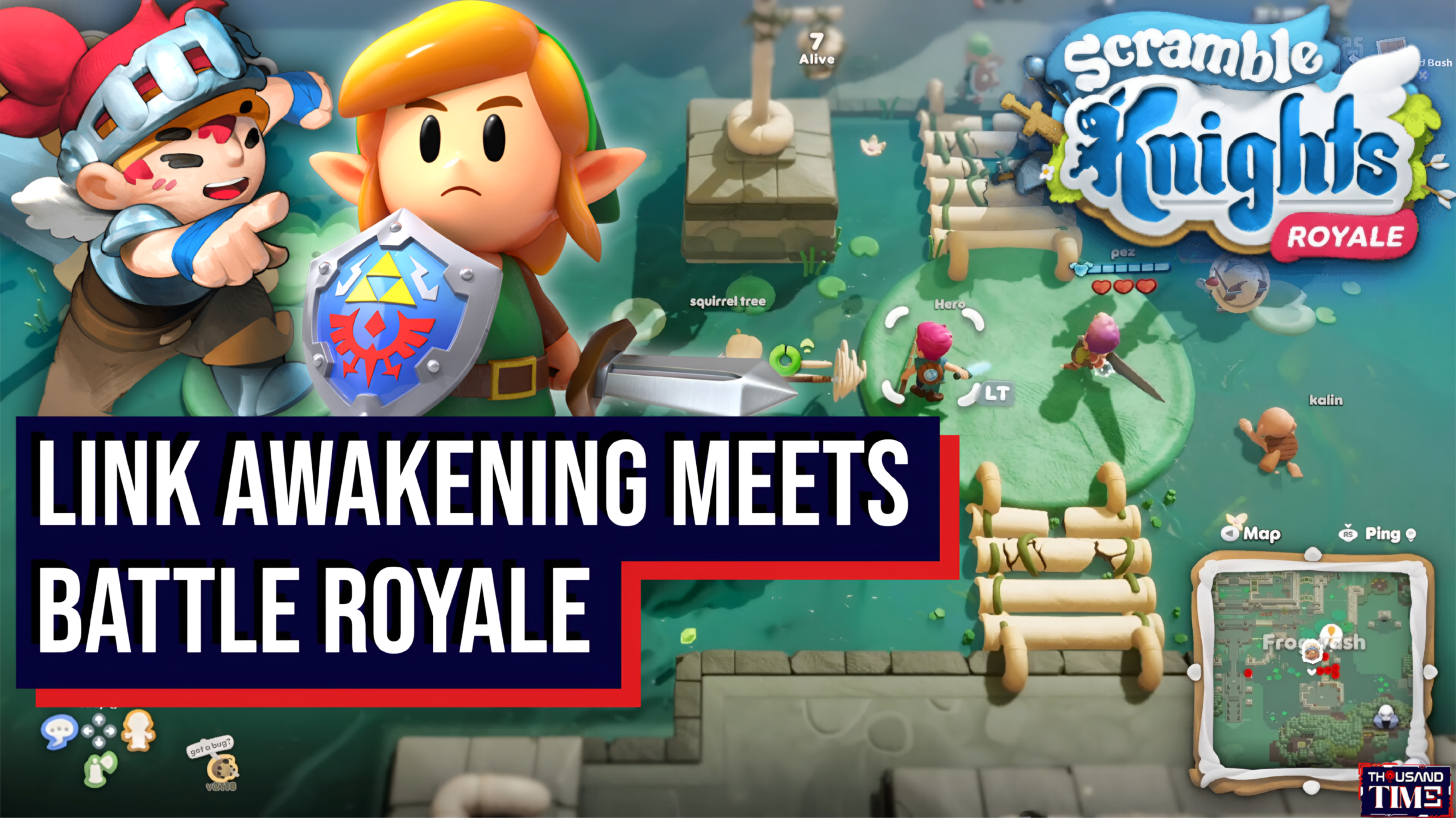
If you’re suffering from severe shooter fatigue, this top-down, sword-swinging PvEvP arena might be the exact palette cleanser you’ve been searching for.
Picture the familiar ritual. You queue up, the lobby fills, you’re launched from a plane or a bus or a boat. You hit the ground running, scan the nearest building, and desperately rummage for something — anything — to shoot back with. A pistol. A shotgun. A rifle with a scope that feels slightly too good for someone this early in the game. You find it. Someone else finds theirs faster. You’re dead in forty seconds. Then you do it again.
Battle royale fatigue isn’t really about the genre being bad. The shrinking circle is genuinely brilliant game design — it creates urgency, forces confrontation, and ensures every match has a natural dramatic arc. The problem isn’t the format. It’s that virtually every game using it has decided the answer to “what do players do inside the circle?” is the same: find a gun, aim at another human, pull the trigger. The genre didn’t run out of ideas. It just stopped looking for them.
Enter the small but increasingly loud category of battle royale games without guns — and right at the front of that conversation, with a beta that clocked over ten thousand rounds played in testing alone: Scramble Knights Royale.
Trading Bullets for Broadswords
Scramble Knights Royale is, mechanically, exactly what it sounds like. Funktronic Labs has built a battle royale that blends classic top-down action inspired by The Legend of Zelda with modern battle royale mechanics, dropping up to 32 players into a match that looks and feels less like Warzone and more like someone took A Link to the Past and asked what it would look like with a shrinking ring and a lobby full of strangers.
The shift in perspective alone changes everything. In a first-person shooter, the primary skill being tested is whether your crosshair lands on a head before someone else’s does. Twitch reflexes, mouse sensitivity, the particular neurological blessing of being able to track movement at distance. It’s a real skill — but it’s a narrow one, and it’s been the genre’s entire identity for years.
Top-down combat asks something different. Spatial awareness. Cooldown management. Understanding your character’s moveset well enough to know when to engage and when to roll sideways and let an attack miss by half a tile. There are no headshots in Scramble Knights Royale. There are dodge rolls, melee weapons, armor sets, and the very old-school satisfaction of reading an opponent’s animation and responding correctly.
It’s closer to a fighting game mentality than a shooting one. Which, if you’ve spent the last few years watching the battle royale space calcify around a single input model, feels almost radical.
Farm First, Fight Later
Here’s where the design gets genuinely interesting, and where Scramble Knights Royale earns the PvEvP label it carries.
Each match begins with players jumping off a starting boat and sailing toward shore on the back of a turtle, which says something about the game’s whole personality before a single sword has been swung. From there, players traverse an archipelago filled with life, puzzles, dungeons, and treasures — preparing by finding loot and completing quests as the ring closes to force every knight closer together.
The early game, in other words, is essentially a dungeon crawler. You’re not immediately hunting other players — you’re farming AI enemies, looting chests, and visiting blacksmiths to spend collected gems on upgrades. Players can master different weapon movesets and create powerful builds through equipment choices, which means the gear you arrive to the late-game PvP fights with is largely a result of how well you managed the PvE phase that preceded them.
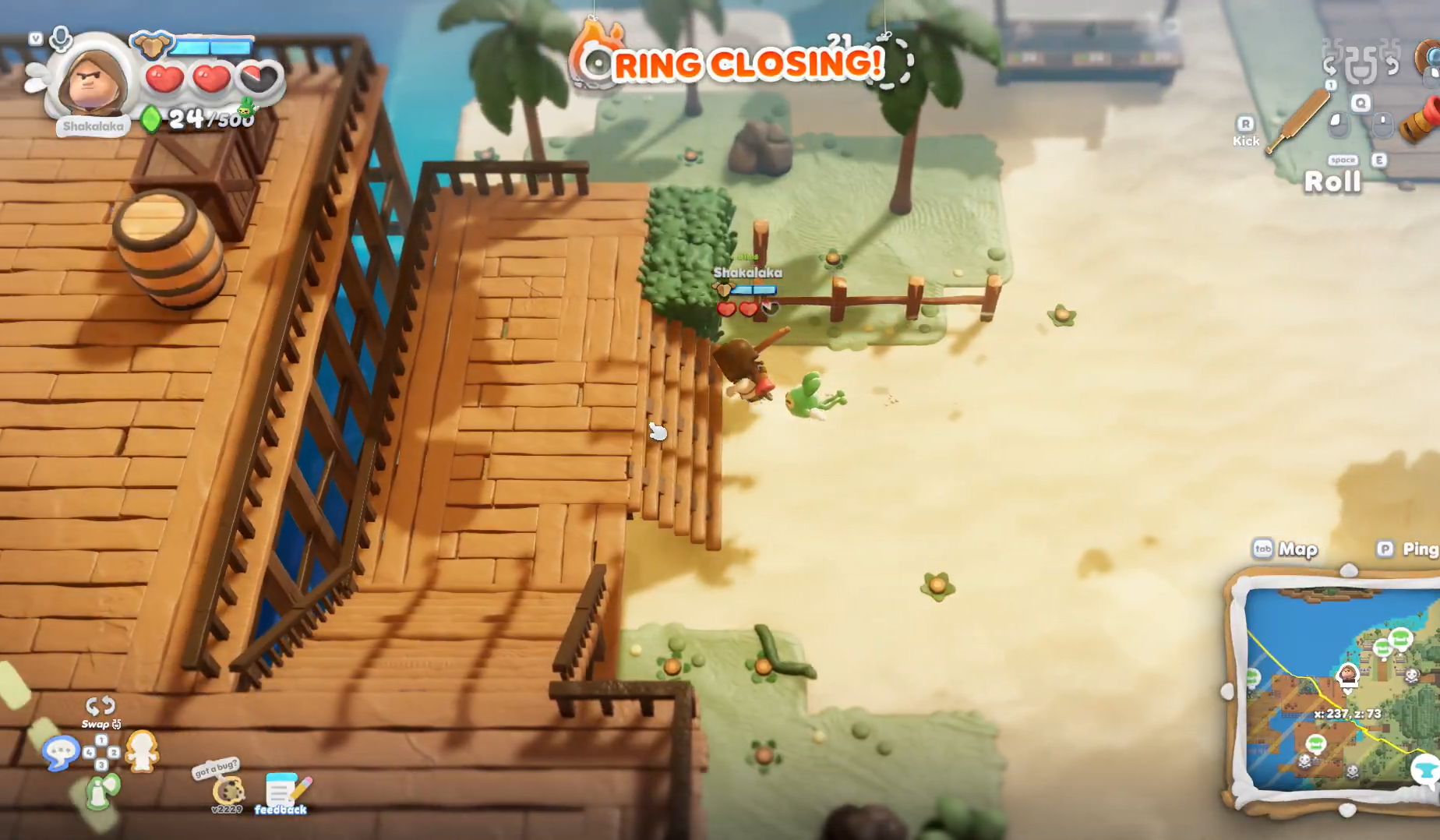
This is a structure that MOBA players will recognize immediately. League of Legends has trained an entire generation of players to think about the “farming versus fighting” balance — when to prioritize getting stronger versus when to contest objectives.Scramble Knights applies that same tension to a shrinking map. Go too deep into a dungeon and you’re better geared but potentially caught in the closing ring. Play too cautiously and you’re alive but underpowered when it matters.
It’s a cleverer loop than it first appears, and it rewards the kind of in-match decision-making that pure shooters rarely demand.
What Funktronic Labs has done is ask a different question. Not “how do we make a better battle royale shooter?” but “what else could the battle royale format actually be?” It turns out the answer, at least in this case, is a top-down fantasy adventure with dungeon crawling, blacksmith upgrades, and a chicken-based spectator mode.
No two matches play out the same, thanks to its dynamic world design and varied progression paths — and that variety, combined with the mechanical shift away from gunplay entirely, makes the game feel genuinely fresh rather than simply different for different’s sake. COGconnected
The battle royale genre isn’t dying. It just needed someone to stop staring at the weapons and start looking at the map.
What Funktronic Labs has done is ask a different question. Not “how do we make a better battle royale shooter?” but “what else could the battle royale format actually be?” It turns out the answer, at least in this case, is a top-down fantasy adventure with dungeon crawling, blacksmith upgrades, and a chicken-based spectator mode.
No two matches play out the same, thanks to its dynamic world design and varied progression paths — and that variety, combined with the mechanical shift away from gunplay entirely, makes the game feel genuinely fresh rather than simply different for different’s sake. COGconnected
The battle royale genre isn’t dying. It just needed someone to stop staring at the weapons and start looking at the map.
Who Actually Needs This Game
If you’ve logged hundreds of hours in Fortnite, Apex, or Warzone and feel a creeping sense that you’re no longer enjoying yourself so much as maintaining a habit, this is almost certainly worth your time. If you grew up playing top-down Zelda games and have spent years wishing someone would take that combat feel into a multiplayer arena, this game is speaking directly to you. If you like the pressure and chaos of battle royale games or the fun of co-op games like Peak or Repo, then Scramble Knights Royale just might be for you — and that framing, straight from the developers, is admirably honest about the audience they’re building for.
The co-op structure helps too. The game supports online split-screen co-op, allowing local friends to play together against other online players — a feature that feels almost nostalgic in the current era of gaming, where couch co-op has increasingly become a selling point precisely because it’s become rare. There’s also the small touch that when you die, you can watch the rest of the match as a chicken, which is either a minor detail or the most important thing in this article depending on your disposition.
Who probably shouldn’t bother? Hardcore tactical shooter players for whom a match’s legitimacy is measured by kill-death ratios and weapon recoil modeling. Players who genuinely dislike AI enemies appearing in their competitive lobbies — the PvE phase isn’t optional, it’s structural. And anyone expecting the scale of a hundred-player lobby will find the 32-player cap feels intimate by comparison, though the game’s developers have noted that maintaining lobby quality was a deliberate trade-off.
That last point matters. Playtesting showed a clear challenge in maintaining high-energy magic during off-peak hours and in smaller regions, which is the honest admission of a studio that understands the particular fragility of an online game that needs people in it to function. It’s something to keep in mind — not as a criticism, but as context.
Thousandtime Thoughts
What Scramble Knights Royale really illustrates is something the games industry relearns every few years: the most effective way to revive a saturated genre isn’t to outperform it on its own terms. It’s to borrow the format and refuse the assumptions that came with it.
The shrinking circle is a design solution to a problem — how do you keep players engaged and encounters inevitable in a large multiplayer space? That solution works just as well with swords as it does with sniper rifles. Probably better, in some ways, because the skill ceiling looks different and the audience it excludes is different too.
There’s a broader question sitting underneath this game, one that goes beyond whether Scramble Knights becomes a breakout hit. If the battle royale format this readily accommodates top-down fantasy, what else is it quietly compatible with? What other exhausted genres are waiting for someone to apply a shrinking ring and thirty-two players and see what happens?
That’s not a rhetorical gesture. It feels like a genuinely open question — and games like this are the reason it’s worth asking.
Content you might like after reading this
Belmont’s Curse: The True Origin…
Why Pokémon Pokopia Sold 2.2…
Rinthine Game Early Access: Survival…
Darwin’s Paradox Review: Is the…