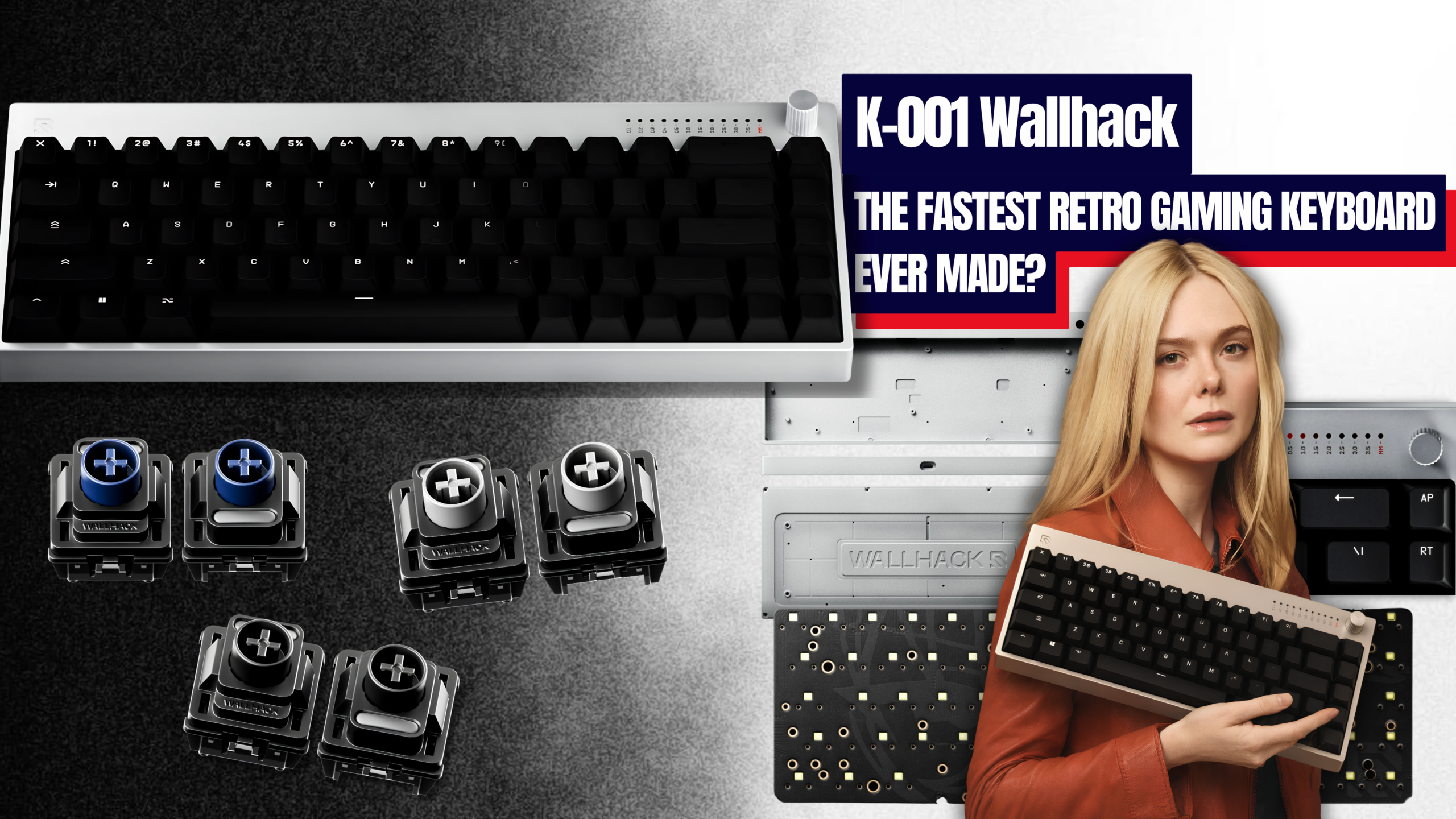
A mousepad company just named its first keyboard after the exploit that gets players banned in competitive shooters — and somehow, it works. Here’s what’s actually inside the K-001, and who it’s really for.
Say “wallhack” out loud in a competitive lobby and watch what happens. It isn’t slang for something clever. It’s an accusation — the word a player reaches for right before someone gets reported, muted, and banned for seeing through walls they were never supposed to see through. So when a gaming peripheral brand released its first keyboard on July 24 and named it after that exact word, it raised a question nobody in the coverage since has quite answered: why is it called the Wallhack K-001, and does a keyboard get to borrow language that usually ends in a ban?
That’s the real story here, and it’s worth more than a spec sheet. Wallhack, a company that built its reputation on glass mousepads and not mechanical switches, just launched its first keyboard, the K-001, alongside a companion mouse called the M-001. Both landed straight into a Hall-effect keyboard market that already has more entrants than most people outside it could name.
86 TOPS, Some Assembly Required
If you didn’t grow up dying to one, here’s the short version: a wallhack, often filed under the wider term ESP (extrasensory perception), is cheat software that renders walls, floors, and cover transparent, or overlays enemy positions on top of them. It’s been part of PC shooter culture since the Quake and early Counter-Strike years, and it remains one of the most reliable ways to get permanently banned from a competitive title. Entire anti-cheat systems exist mainly to catch this specific behavior. Ask anyone who’s spent real time in ranked queues and they won’t need the definition. They’ll just wince.
Which makes the branding logic fairly easy to read, even if nobody at the company has said it in so many words. Wallhack is betting that gamers will hear the name and register it as a wink, not an endorsement — we know this word, we know exactly what it means to you, and we’re clearly not a boardroom that focus-grouped this into something safer. It’s the same instinct that’s pushed energy drink brands and streetwear labels to lift slang straight from the subcultures they’re courting. Most borrowed slang, though, doesn’t come with a ban attached.
Which leaves an open question the spec-sheet coverage hasn’t really engaged with: does the name set an expectation the keyboard then has to meet? Calling a keyboard “Wallhack” implies an edge. The illegal version gives you information you’re not supposed to have. Does the K-001 give you speed you’re not supposed to have — legitimately, through actuation tuning and reaction time — or is the name just a joke that happens to ship in a nice aluminum case?
Underneath the Joke, an Actual Keyboard
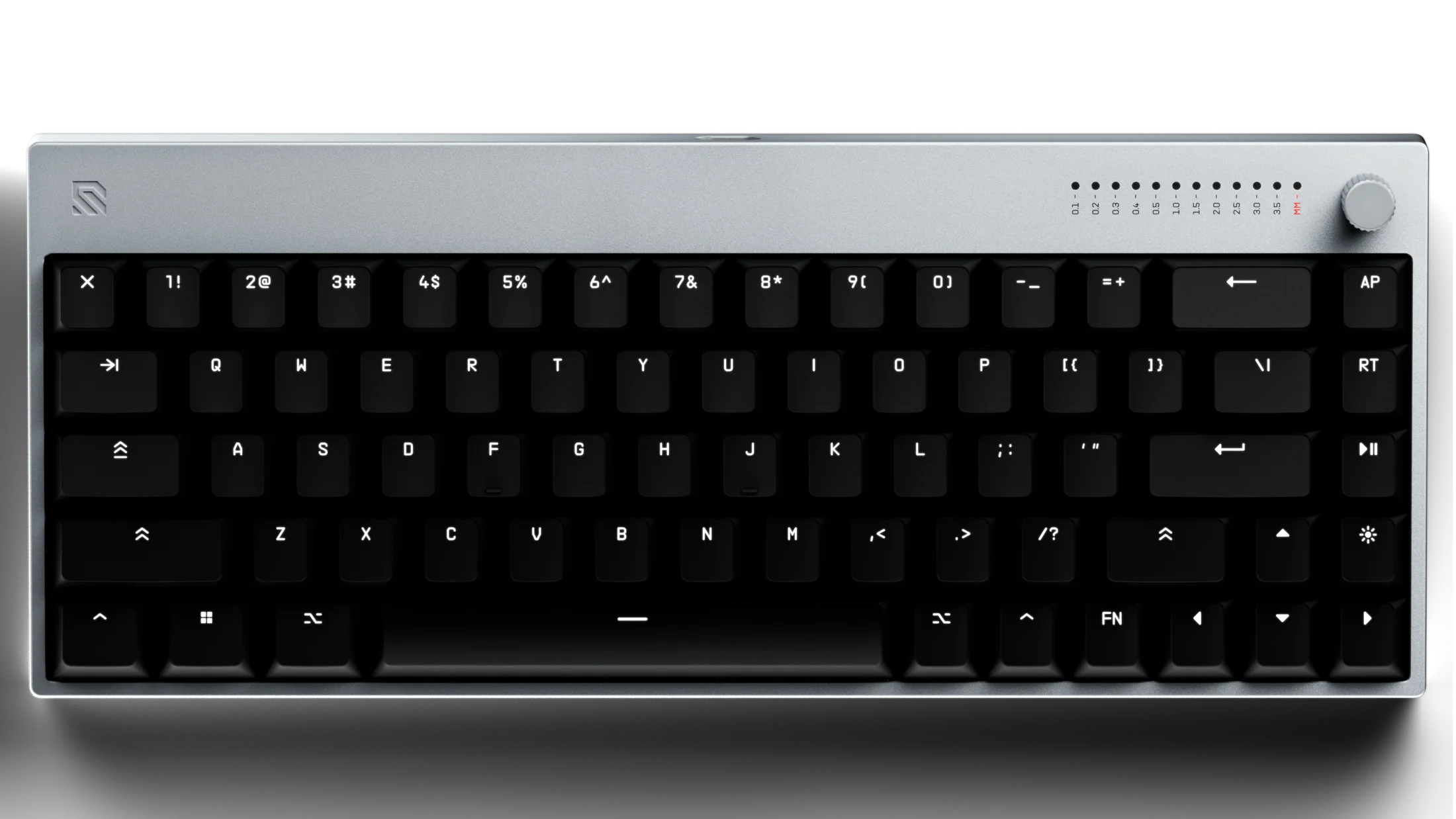
Strip away the name and the K-001 reads like it was built by people who’ve actually queued for rank, not by a marketing team’s idea of what that looks like. The case is CNC-machined from 6063 aluminum, bead-blasted and anodized, in two colorways, a lighter “Natural” finish and a darker “Slate,” both leaning retro-industrial rather than gamer-RGB. The layout is 65%: no numpad, a tightened footprint, the format competitive players tend to prefer because it frees up desk space for mouse movement.
The switches are the more interesting story. Early coverage guessed they were customized Gateron Dual-Drive units, working off leaked images alone — a reasonable guess, and not quite the full picture. Wallhack’s own materials name them the KS-TR Linear switch, co-developed with Gateron, available in three spring weights: Light, Medium, and Heavy, with Medium shipping standard and the other two sold separately. Because they’re magnetic Hall-effect switches, actuation point and rapid trigger sensitivity adjust down to a 0.01mm resolution, fine enough that most of that range lives well below what a finger can consciously register.
Here’s the detail that matters more than the number itself: none of that requires software. A physical stepped dial handles actuation and rapid trigger directly on the keyboard, which is Wallhack’s answer to a category of hardware that has historically demanded you install something clunky just to remap a key. For the deeper settings (SOCD input handling, gamepad emulation), there’s Wallhack Terminal, a browser-based tool that runs with nothing downloaded to your machine at all.
The rest reads like a checklist assembled by people who’ve complained about keyboards before: swappable 4° and 7° risers (it ships flat at 0°), a four-layer sound-dampening stack — anodized aluminum plate, silicone, foam, and a thin plastic film — built for what Wallhack calls a “crisp and clacky” typing sound instead of the hollow clatter cheaper boards are known for, and double-shot PBT keycaps built around a light-guide structure meant to stop backlighting from bleeding out past the letters. The connection is wired: a plain 1.8-meter USB-C to USB-A cable, running 8,000Hz polling and a 16,000Hz scan rate. The companion M-001 mouse goes wireless.
The keyboard doesn’t.
Worth remembering, too, that all of this is impressive for a first attempt — and that’s exactly what it is. A first attempt, from a brand whose retail history starts with a mousepad, not a mechanical switch.
Who Actually Want This
The specs answer whether this keyboard can perform. They don’t answer whether you should buy it, and that turns out to be a different, more complicated question.
If you’re a competitive or rank-focused player who already understands rapid trigger and wants that tuning available on the hardware itself, without opening an app every time you adjust your setup, the K-001 was built for exactly you. So was anyone whose desk is part of the appeal — the CNC aluminum and restrained retro styling are doing real aesthetic work here, not just performance work. And if you’re the type who enjoys being early, comfortable buying a first-generation product from a company with zero keyboard track record in exchange for having it before everyone else, this scratches that itch too.
For other people, the fit narrows. This is a 65% board, full stop, so anyone who needs a numpad for spreadsheets or Discord math between matches should look elsewhere. It’s wired, not wireless — a real distinction, given the companion mouse went the other way. And then there’s the detail every outlet covering this launch keeps circling without quite landing on: as of this writing, Wallhack still hasn’t confirmed pricing or availability. That’s not a footnote. A keyboard’s value is inseparable from its price, and until that number exists, “worth buying” is a question nobody can fully answer yet, Wallhack included.
There’s also a quieter risk that won’t show up on any spec sheet. This is a company’s first keyboard, not its tenth. Wallhack’s mousepads have earned a genuinely strong reputation, the kind reflected across thousands of customer reviews, but reputation in one category doesn’t automatically transfer to another. Keyboards live or die on firmware updates, RMA support, and whether a company is still around to fix bugs eighteen months after launch. None of that can be tested from a press release.
Buy it if you’re chasing that specific combination of on-device tuning and aluminum-and-retro styling, and you’re fine being an early adopter twice over: early to the product, early to the brand’s new category. Wait if you’re missing a number you can’t live without, whether that’s a numpad or a price tag.
Thousandtime Thoughts
Gaming hardware has always borrowed identity from the culture around it, usually through symbols — a logo, a colorway, a name that just sounds fast. Wallhack skipped the metaphor and went straight for the term itself, the one that actually gets you banned, not teased. That’s a different kind of bet than a cool font. It’s a bet that fluency reads as trust: if a brand knows this word well enough to put it on a box, surely it knows what competitive players actually need.
It’s a clever bet right up until the joke has to share shelf space with a warranty policy. Names built on subcultural slang tend to age one of two ways: they calcify into a brand’s whole identity, worn unironically for a decade, or they curdle into the thing people remember before they remember what the product did. The K-001 looks good enough, on paper, to eventually make its own name beside the point. Whether Wallhack actually wants that — a keyboard that outgrows its own joke — might end up being the more interesting story.
PRODUCT IN THIS POST
K-001 Wallhack Mechanical Keyboard
Content you might like after reading this
How Jensen Huang Engineered RTX…
Is the LGG Saturn Pro…
NASA Artemis Watch 2.0: The…
AM Infinity Review: When a…
Valve’s Ibex Just Rewrote the…
Is the MacBook Neo Good…
Is the Corsair Vanguard Air…

Should You Wait for the…
Surface Pro 11 Long-Term Review:…
Best Controller for Docked ROG…
Galaxy Buds 4 Pro Without…
GPD Win 5 Review: Can…
AndaSeat Novice Review: The “Stealth”…
Razer Viper V3 Pro vs.…
How Intel’s New “Binary Tool”…
The iKKO Mind One: 2026’s…
The Mountain Everest Max: Is…
Samsung Galaxy S26 Ultra: How…
Zenbook Duo Review: Can One…